
This study examined how software engineers’ perceptions of their supervisors’ communication orientations (i.e., solution-focused and problem-focused approaches) and empathic attitudes are related to their work engagement. In recent years, with the advancement of economic digitalization and innovation, effective management of knowledge workers—whose contributions are grounded in advanced expertise and specialized skills—has become increasingly important (Drucker, 1999; Powell & Snellman, 2004). In particular, management through communication with engineers engaged in software development, which underpins modern industrial infrastructure, has attracted growing scholarly attention (R. M. Grant, 2013; Meyer et al., 2017, 2021; Nickerson & Zenger, 2004). Because software development is driven primarily by sophisticated cognitive activities such as problem identification, root-cause analysis, design, and implementation (Meyer et al., 2017, 2021), it is difficult for supervisors to oversee and control every aspect of their employees’ work; consequently, relationship-based management grounded in dialogue and support becomes essential. Moreover, while modular design is effective in software development, a more critical issue is how inter-module coordination is achieved—specifically, non-structural interfaces such as shared language, shared values, and alignment on strategy and objectives, which are recognized as enabling flexible and rich coordination across modules (R. M. Grant, 2013). These non-structural interfaces are elements that supervisors should cultivate in their teams through day-to-day communication, and the quality of supervisors’ communication can be considered a key determinant of the quality of inter-module coordination. Furthermore, in high-complexity tasks characterized by substantial knowledge interdependence—such as software development—it is known that consensus-based decision-making outperforms authority-based, centralized decision-making (Nickerson & Zenger, 2004). The process by which supervisors draw out knowledge and build consensus through deep dialogue with employees can itself serve as a source of organizational capability. In this way, bidirectional communication between supervisors and employees is expected to be a key driver of organizational performance in the management of knowledge workers, of whom software engineers are a prime example.
Although work engagement is empirically related to but conceptually distinct from employee well-being (Bosle et al., 2021), it has been widely recognized as one of its central indicators (Salanova et al., 2024), and there is a growing international trend toward recognizing the well-being of employees—including that of software engineers—as a critical organizational resource (WHO, 2010). Against this backdrop, companies have come to place increasing emphasis on fostering positive psychological states among their employees, such as vigor and dedication, as exemplified by work engagement. This trend is particularly pronounced in Japan, where the practice of kenkou keiei (corporate health and productivity management) – a corporate strategy systematically designed to promote employee well-being – has gained widespread adoption. It has been confirmed that corporate health and productivity management initiatives improve labor productivity by enhancing work engagement (Yamamoto et al., 2021), and that companies with higher health and productivity management ratings tend to demonstrate better future profitability (Yano et al., 2022). In the context of recent Environmental, Social, and Governance (ESG) investment, health and productivity management is positioned as investment in “human capital” and has become a highly regarded non-financial metric among investors (Ozaki, 2017). Paralleling this shift in corporate management thinking, regulatory and institutional developments that link human capital to corporate value have also accelerated. In Japan, the mandatory stress check program introduced in 2015 institutionalized the monitoring of psychological health (Ministry of Health, Labour and Welfare, 2015); internationally, examples include the publication of ISO 30414 by the International Organization for Standardization (ISO, 2018) which requires the disclosure of human capital information, and the mandated human capital disclosure requirements introduced by the U.S. Securities and Exchange Commission (SEC, 2020). Against this backdrop of growing attention to well-being, interest in work engagement—as a central indicator of employees’ sustained vitality and performance—has been increasing both in practice and in scholarship (Bakker & Demerouti, 2008). However, empirical research specifically addressing the psychological aspects and well-being of software engineers remains limited (Godliauskas & Šmite, 2025).
According to Schaufeli et al. (2002), “Engagement is defined as a positive, fulfilling, work-related state of mind that is characterized by vigor, dedication, and absorption” (p.74), and is measured with the Utrecht Work Engagement Scale (Shimazu et al., 2008). It is conceptualized not as a momentary emotion but as a persistent, work-directed motivational state. In particular, the Job Demands–Resources (JD-R) model posits that job resources enhance employees’ work engagement, which in turn leads to improved performance and reduced turnover (Bakker & Demerouti, 2008; Schaufeli & Bakker, 2004). Job resources that are thought to influence work engagement include autonomy, social support, and feedback at work, among others; notably, recent research has highlighted supervisory involvement as an important factor in enhancing employee engagement (Bakker & Demerouti, 2007; Knight et al., 2019).
Growing expectations for supervisors to support employees’ career development (Ministry of Health, Labour and Welfare, 2022), together with the increasing number of companies institutionalizing one-on-one meetings (Recruit Management Solutions, 2022), have drawn practical attention to the ways in which supervisory involvement serves as a key to enhancing employees’ work motivation. Nevertheless, empirical research on which specific forms of supervisory involvement improve employees’ work engagement remains in its early stages. Regarding supervisors’ engagement in one-on-one meetings in particular, while some studies have found that the frequency (quantity) of such meetings positively influences work outcomes through work engagement (Furuta, 2023), questions about quality remain unresolved. Therefore, this study focuses on employees’ perceptions of supervisors’ communication orientations (solution-focused and problem-focused) and supervisors’ empathic attitudes in one-on-one meetings between supervisors and employees among software engineers and examines the effects of these orientations and attitudes on employees’ work engagement.
Our study is a quantitative empirical study based on a questionnaire survey. This research method stands in methodological tension with the social constructivism on which solution-focused therapy is based. Social constructivism views meaning, identities, and realities as co-constructed through dialogue and interaction rather than as stable entities that can be objectively measured. In contrast, the present study operationalizes communication patterns and relational experiences as measurable variables and examines their statistical associations with work engagement. However, since patterns of communication within an organization are thought to be able to be measured through employees’ perceptions, it is considered feasible to treat these as variables and conduct empirical research. While this approach allows us to understand the relationship between communication and work engagement as an inter-variable relationship, it is difficult to gain insight into the process by which the meaning of work for employees is constructed through solution-focused interactions. To analyze these processes, a qualitative methodology grounded in social constructivism will likely be necessary.
The Relationship Between Employees’ Perceptions of Supervisors’ Empathic Attitudes and Employees’ Work Engagement
Barrett-Lennard (1981) proposed a model of empathy consisting of a cyclical process in which the counselor first strives to understand and share the client’s inner world through attentive listening (Phase I), then communicates this understanding back to the client through verbal responses (Phase II), and finally the client experiences a sense of being understood by the counselor (Phase III). The client subsequently continues self-exploration, and the cycle begins again. Adopting the terminology used by Tanaka (2006), the present study refers to Phase I as empathic understanding, Phase II as empathic communication, and Phase III as perceived empathy. A substantial body of empirical research has examined the relationship between empathy and counseling outcomes. These studies have consistently suggested that empathy contributes to positive counseling outcomes largely through clients’ perceptions that they are genuinely understood by the counselor (Barrett-Lennard, 1981; Greenberg et al., 2001). In other words, empathic understanding and empathic communication are thought to influence outcomes primarily when they are successfully conveyed to and recognized by the client as empathy. Although these findings originate from counseling research, a similar process may operate in supervisor–employee relationships. When employees perceive that their supervisor genuinely understands their experiences, concerns, and emotions, they are more likely to feel accepted and supported. Therefore, the present study focuses on employees’ perceptions of supervisors’ empathic attitudes. Specifically, employees’ perceptions of supervisors’ empathic attitudes are defined as employees’ perceptions that their supervisor understands and responds appropriately to their experiences and emotions, reflecting Phase III of Barrett-Lennard’s model.
The Job Demands–Resources (JD-R) model demonstrates that social resources present in the workplace are a key factor in enhancing work engagement (Bakker & Demerouti, 2007). According to this model, social resources such as supervisory support and feedback, as well as the quality of interpersonal relationships, promote employees’ work engagement by enhancing their sense of meaning and accomplishment at work. In particular, emotional support from supervisors has been shown to increase employee motivation and job satisfaction as a social resource in the workplace (House, 1981), and such support is thought to enhance the degree to which employees engage with their work. For example, when employees perceive empathy from their supervisors, they are more likely to feel that their experiences and difficulties are understood, thereby replenishing their psychological resources. As a result, their proactive engagement and work-related energy directed toward their job are expected to increase.
Employees’ perceptions of supervisors’ empathic attitudes also serve as a factor that enhances the quality of the supervisor–employee relationship. It has been noted that the sense of being empathically understood by another person reduces defensiveness in the individual and promotes self-disclosure and relational engagement (Rogers, 1957). Such experiences of understanding and acceptance increase feelings of safety and mutuality in interpersonal relationships, ultimately contributing to the formation of trust and improving relationship quality. When a supervisor demonstrates a genuine effort to understand an employee’s emotions and circumstances, the employee comes to perceive the quality of that relationship more positively, and their motivation to engage actively with their work is expected to increase. Based on the foregoing discussion, supervisors’ emotional support—and employees’ perceptions of supervisors’ empathic attitudes in particular—are anticipated to function as social resources in the workplace, replenishing employees’ psychological resources while also enhancing their vigor and dedication toward work. Accordingly, the following hypothesis was formulated:
Hypothesis 1: Employees’ perceptions of supervisors’ empathic attitudes positively predict employees’ work engagement.
A Solution-Focused Approach to Promoting Work Engagement
The solution-focused approach originated in the field of psychotherapy during the 1980s. It was created primarily by Steve de Shazer and Insoo Kim Berg at the Brief Family Therapy Center (BFTC) in Milwaukee, Wisconsin. Solution-focused therapy, rather than investigating the causes of clients’ problems, seeks to inquire into the possibilities and strengths that clients already possess and to expand and utilize them (De Jong & Berg, 2013; De Shazer, 1994).
In many forms of psychotherapy, conventional therapeutic approaches often involve exploring past experiences that gave rise to clients’ problems, modifying the cognitions that perpetuate those problems, or teaching new skills to overcome them. This type of approach is referred to as problem-focused. In contrast, the solution-focused approach focuses on constructing a desired solution state that the client desires by identifying areas where the client is already coping successfully, clarifying the future they wish to achieve, and organizing what they are already doing to realize that future (Ito, 2021). The solution-focused approach has been shown to produce therapeutic effects more rapidly than conventional methods (Gingerich & Peterson, 2013). According to Gingerich & Peterson (2013)’s systematic review, SFBT was found to be comparable to well-established alternative treatments for adult depression, and studies examining treatment length indicated that SFBT often achieved similar outcomes with fewer sessions. The success of the solution-focused approach in therapy has attracted attention from a wide range of fields, including hospitals, schools, bullying prevention, prisons, treatment of alcohol addiction, graduate supervision, and local government (De Jong & Berg, 2013).
From a coaching perspective, numerous comparative studies of solution-focused and problem-focused approaches have been reported, consistently demonstrating the relative effectiveness of the solution-focused approach. For example, its relative effectiveness has been demonstrated in terms of increases in self-efficacy and positive affect, reductions in negative affect (A. M. Grant, 2012; A. M. Grant & Gerrard, 2020; A. M. Grant & O’Connor, 2010, 2018), improvements in cognitive flexibility (Theeboom et al., 2016), and increases in goal attainability (Abdulla & Woods, 2020). In Japan as well, a study of university students and working adults reported that the solution-focused approach was more effective than the problem-focused approach in enhancing self-efficacy and reducing negative affect (Kitai et al., 2023).
Furthermore, Kitai (2020) suggested through quantitative research that a solution-focused approach enhances work engagement. Drawing on the JD-R model discussed above, we argue that the solution-focused approach enhances work engagement by improving self-efficacy, positive affect, cognitive flexibility, and goal attainability—all of which constitute personal resources. However, Kitai (2020) examined communication in organizational settings in general and did not specifically investigate communication between supervisors and employees. We therefore formulate the following hypothesis to examine whether the solution-focused approach—which seeks to inquire into and expand upon employees’ possibilities and strengths—is also effective in the context of supervisor–employee communication:
Hypothesis 2: Employees’ perceptions of supervisors’ solution-focused approach positively predict employees’ work engagement.
The Limited Association Between Problem-Focused Communication and Work Engagement
Problem-focused therapy – that is, therapy that concentrates on problems and their causes—has been shown to reduce anxiety to some extent (Cooper, 2008). However, a review of prior research indicates that its impact on personal resources is smaller than that of the solution-focused approach (Kitai et al., 2023). Moreover, Kitai (2020) found that problem-focused communication had no significant effect on work engagement. When problem-focused communication takes place between a supervisor and an employee, there is a risk that employees experiencing difficulties or problems may come to perceive themselves as victims. In addition, the pursuit of root causes may increase the likelihood that employees feel blamed (De Jong & Berg, 2013). In such communication, it is difficult to enhance employees’ resources, and the effectiveness of supervisory support is likely to be limited. The following hypothesis can therefore be proposed:
Hypothesis 3: Employees’ perceptions of supervisors’ problem-focused approach are expected to show a weak or non-significant association with employees’ work engagement.
The Moderating Role of Employees’ Perceptions of Supervisors’ Empathic Attitudes
Solution-focused communication does not, however, always enhance employees’ work engagement. When a supervisor pushes toward solutions without listening to what employees wish to say, or when solution-focused questions are posed at a time when an employee wants to talk about a problem, the employee may feel that they are being disregarded. Jackson and McKergow (2007) describe this kind of questioning not as solution-focused but as “solution-forced.” When the other party perceives questions as coercive, self-efficacy and positive affect are unlikely to improve.
Eve Lipchik, one of the central members of the aforementioned BFTC, argued that the cornerstone of the therapist–client relationship is trust, and that an emotionally comfortable relationship between therapist and client should therefore be established (Lipchik, 2002). Such a trusting relationship is equally necessary in the context of one-on-one supervisor–employee interactions.
In particular, the “visitor” relationship type in SFBT—which Iwakabe (2018) relates to the precontemplation stage of the transtheoretical model of change—refers to situations in which it is important to listen to the client’s perspective without negating it. Translated into the supervisor-employee context, this corresponds to situations in which a shared awareness of the issues at hand has not yet been established, or in which sufficient trust between supervisor and employee has not yet been formed. If solution-focused questions are posed abruptly in such situations, employees may not perceive their supervisor as being supportive and may instead feel as though they are being evaluated. Solution-focused communication can exert its effects when a trusting relationship exists between supervisor and employee. The formation of such trust depends on employees’ perceptions of supervisors’ empathic attitudes – that is, on the employee’s conviction that the supervisor genuinely seeks to understand them. The following hypothesis can therefore be proposed:
Hypothesis 4: Employees’ perceptions of supervisors’ empathic attitudes moderate (strengthen) the relationship between employees’ perceptions of solution-focused approach and employees’ work engagement.
Method
Participants
A survey was administered to panel members registered with an online survey company who were aged 20 to 59 years. The mean age of respondents was 48.30 years (SD = 8.49, range: 20–59). Data were collected in January 2023. A total of 1,500 responses were included in the analysis, collected through a screening survey (N = 7,241) followed by a main survey. Participants were selected through the screening survey based on two criteria: (1) being employed in a role related to software development (including systems planning, design, development, and operations), and (2) having opportunities for one-on-one meetings with their direct supervisor at least once every two to three months. Because the survey was administered through an online survey company, information regarding the number of individuals invited to participate was not available. Prior to conducting the study, ethical approval was obtained from the Research Ethics Review Committee for Human Subjects at the first author’s affiliated institution (approval number: 2022-60).
Measures
We measured employees’ perceptions of their supervisors’ solution-focused approach (hereafter, perceived solution-focused approach), problem-focused approach (perceived problem-focused approach), and empathic attitudes (perceived empathic attitudes).
Perceived Solution-Focused Approach and Problem-Focused Approach
Items measuring perceived solution-focused approach and problem-focused approach were developed based on Kitai and Shimada (2022). Whereas the original scale was designed to capture general conversational content among coworkers in the workplace, the present study focuses specifically on the context of one-on-one meetings between supervisors and employees. Accordingly, items from the original 16-item pool were reviewed and selected based on their relevance and applicability to this more specific one-on-one context, and the wording was adapted accordingly. Item content was reviewed by the authors, who specialize in industrial-organizational psychology and organizational behavior, respectively; no pilot testing was conducted. This context-driven selection process resulted in six items being retained to assess perceived solution-focused approach, including “Topics related to your ‘successes’ or ‘growth’ are frequently discussed” and “We often talk about the ‘ideals’ or ‘dreams’ we have for our work or organization,” and four items being retained to assess supervisors’ problem-focused approach, including “Conversations tend to focus more on ‘what is lacking’ than on existing ‘strengths’” and “When a problem occurs, conversations often center on identifying its cause or finding someone to blame.” More problem-focused items than solution-focused items were judged to be less applicable to the one-on-one supervisor-subordinate context and were therefore not retained, resulting in an initial asymmetry of six solution-focused items versus four problem-focused items. Participants were instructed to respond with reference to “the content of conversations during one-on-one discussions or consultations with your supervisor,” using a five-point scale ranging from 1 (strongly disagree) to 5 (strongly agree), with no reverse-keyed items. Higher scores indicate a stronger tendency toward each respective communication orientation.
To examine the factor structure of the ten items (six solution-focused, four problem-focused), an exploratory factor analysis (maximum likelihood estimation with Promax rotation) was conducted prior to hypothesis testing. Based on the criterion of eigenvalues greater than 1.0, two factors were extracted. In the initial analysis, one item from the problem-focused scale — “Conversations tend to focus more on the present reality than on future ideals” — showed low communality (post-extraction communality = .133) and insufficient factor loadings; this item was therefore removed, and the analysis was repeated. Notably, this item corresponds to Question item 8 in Kitai and Shimada (2022), which was similarly excluded from their final two-factor model because it failed to load clearly onto either the solution-focused or problem-focused factor and instead formed an independent third factor. The convergence of these two independent analyses on the same item further supports the appropriateness of its removal. In the re-analysis with nine items, the six solution-focused items loaded highly on the first factor (loadings ranging from .60 to .79), and the three problem-focused items loaded highly on the second factor (loadings ranging from .53 to .69). These results generally supported the hypothesized two-dimensional structure. Cronbach’s alpha coefficients were .86 for the solution-focused scale and .61 for the problem-focused scale.
Perceived Empathic Attitudes
Seven items were used to measure perceived empathic attitudes. The items were adapted from Tanaka (2006), which is based on Barrett-Lennard’s (1981) model of empathy. Following this model, the present study conceptualizes perceived empathic attitudes as employees’ perceptions that their supervisor understands and appropriately responds to their experiences and emotions, thereby conveying a sense of being understood (Phase III: perceived empathy). Of the 11 items comprising the original scale (Tanaka, 2006), seven were selected a priori by the authors based on their relevance to the context of one-on-one discussions between supervisors and subordinates. Item content was reviewed by the authors, whose areas of expertise are industrial-organizational psychology and organizational behavior, respectively; however, no pilot testing was conducted. Sample items include “I always feel that my supervisor understands me” and “I always feel that my supervisor understands even the things that are difficult for me to say.” Participants were instructed to respond with reference to “what you typically feel during one-on-one discussions or consultations with your supervisor,” using a five-point scale ranging from 1 (strongly disagree) to 5 (strongly agree), with no reverse-keyed items. Higher scores indicate stronger perceived empathic attitudes.
To examine the factor structure of the seven items, an exploratory factor analysis (maximum likelihood estimation) was conducted. One factor with an eigenvalue greater than 1.0 was extracted, accounting for 77.56% of the variance. All items loaded highly on the single factor (loadings ranging from .85 to .90), supporting the unidimensional structure of the scale. Cronbach’s alpha for the present sample was .96.
Work Engagement
Work engagement was assessed using the nine-item Japanese version of the Utrecht Work Engagement Scale (UWES; Shimazu et al., 2008). The UWES measures the degree to which employees feel vigorous, dedicated, and absorbed in their work. Sample items include “When I am working, I feel bursting with energy” and “At my job, I feel strong and vigorous.” Responses were provided on a five-point scale ranging from 1 (almost never) to 5 (always), with no reverse-keyed items. Higher scores indicate greater work engagement. Cronbach’s alpha in the present study was .95.
Demographic Variables
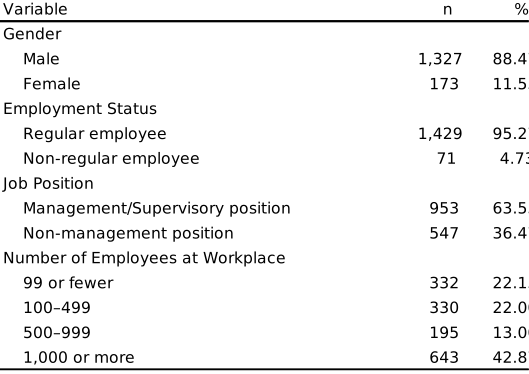
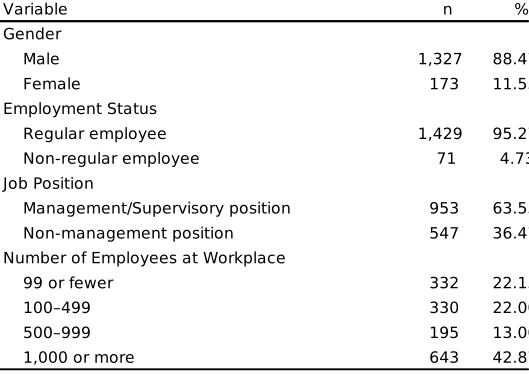
Participants were asked to provide information on gender, age, employment type, managerial status, and the number of employees at their organization. Descriptive statistics for participant demographics are presented in Table 1. Male respondents accounted for 88.5% of the sample, and 95.3% were regular full-time employees. Those holding a managerial or supervisory position comprised 63.5% of respondents. The most common organizational size was 1,000 or more employees, representing 42.9% of the sample.
Results
Preliminary Analyses
Because the present study relied on self-report data from a single source, the data may be susceptible to common method bias (Podsakoff et al., 2003). To examine this potential influence, Harman’s single-factor test (Podsakoff & Organ, 1986) was conducted. An exploratory factor analysis (maximum likelihood estimation with Promax rotation) was performed on all items measuring work engagement, perceived solution-focused approach, perceived problem-focused approach, and perceived empathic attitudes. Four factors with eigenvalues greater than 1.0 were extracted, with the first factor accounting for 43.85% of the variance. The analysis did not indicate that a single method factor dominated the covariance among items. Furthermore, the four extracted factors were consistent with the theoretically assumed constructs of work engagement, perceived solution-focused approach, perceived problem-focused approach, and perceived empathic attitudes.
Descriptive Statistics and Correlations
Descriptive statistics and the results of correlation analyses for all variables are presented in Table 2. Work engagement showed moderate, positive correlations with perceived solution-focused approach (r = .49) and perceived empathic attitudes (r = .44), and a very weak, positive correlation with perceived problem-focused approach (r = .18). Perceived empathic attitudes showed a strong, positive correlation with perceived solution-focused approach (r = .70) and a very weak, positive correlation with perceived problem-focused approach (r = .12). Perceived solution-focused approach and perceived problem-focused approach showed a weak, positive correlation (r = .30).

Hypothesis Testing
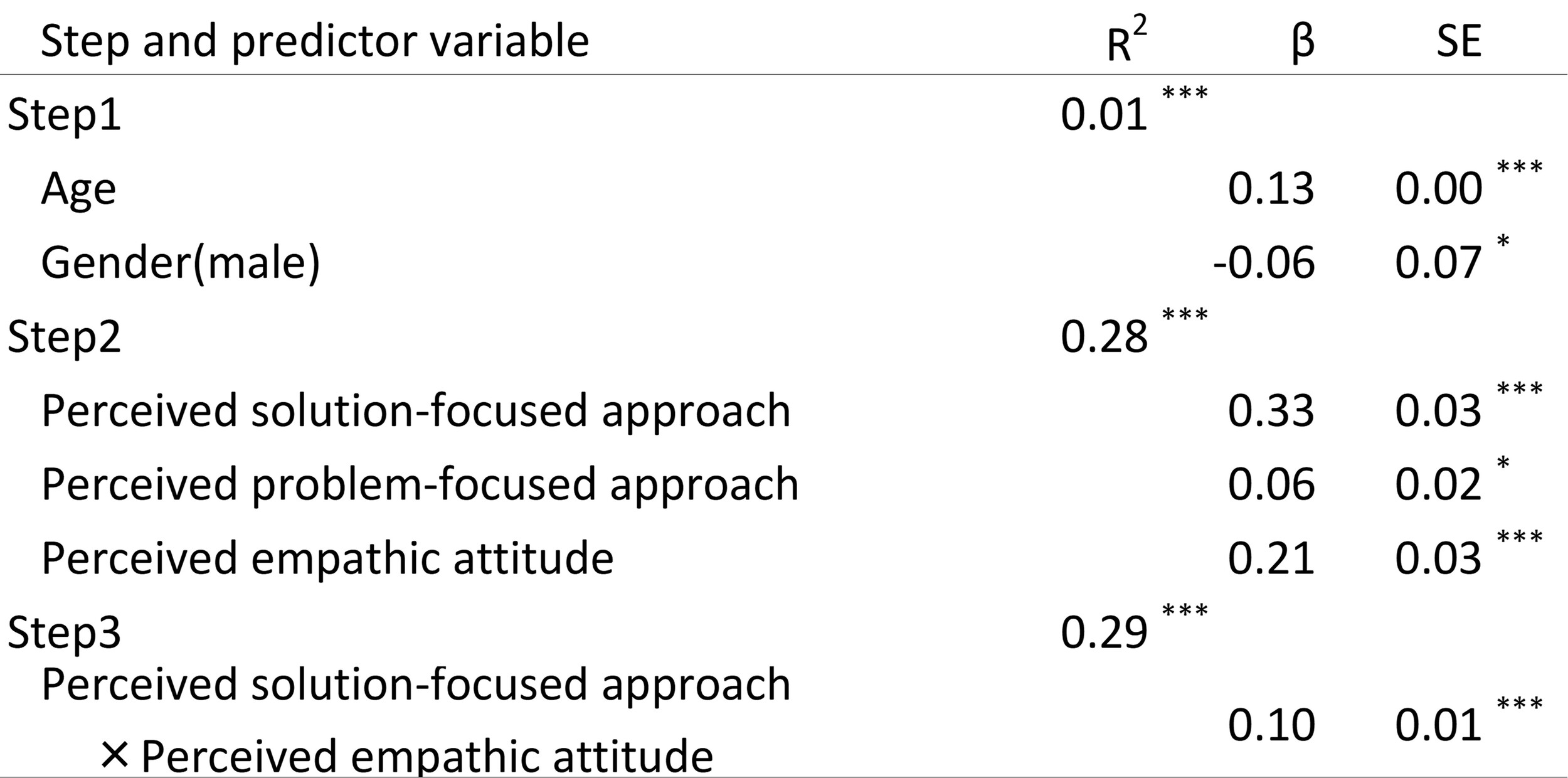
To test the hypotheses, hierarchical multiple regression analysis was conducted using standardized scores for all variables (see Table 3). In STEP1, age and gender were entered as control variables. The overall model was significant, R2 = .015, F (2,1497) =11.76, p< .001.
In STEP2, perceived solution-focused approach, problem-focused approach, and perceived empathic attitudes were added to the model, R2 = .281, ΔR2 = .266, ΔF (3, 1494) = 183.96, p < .001. Age (β = .14, p < .001), perceived solution-focused approach (β = .33, p < .001), and perceived empathic attitudes (β = .21, p < .001) each showed significant positive associations with work engagement. The effect of gender was marginally significant (β = −.05, p < .10). Perceived problem-focused approach also showed a statistically significant association with work engagement (β = .06, p < .05); however, its standardized coefficient was relatively small compared to the other predictors, suggesting a relatively small effect size.
In Step 3, an interaction term between perceived solution-focused approach and perceived empathic attitudes was added to the model, R2 = .290, ΔR2 = .009, ΔF(1, 1493) = 19.11, p < .001. The interaction term showed a significant positive association with work engagement (β = .10, p < .001), indicating that perceived empathic attitudes moderated the relationship between perceived solution-focused approach and employees’ work engagement.
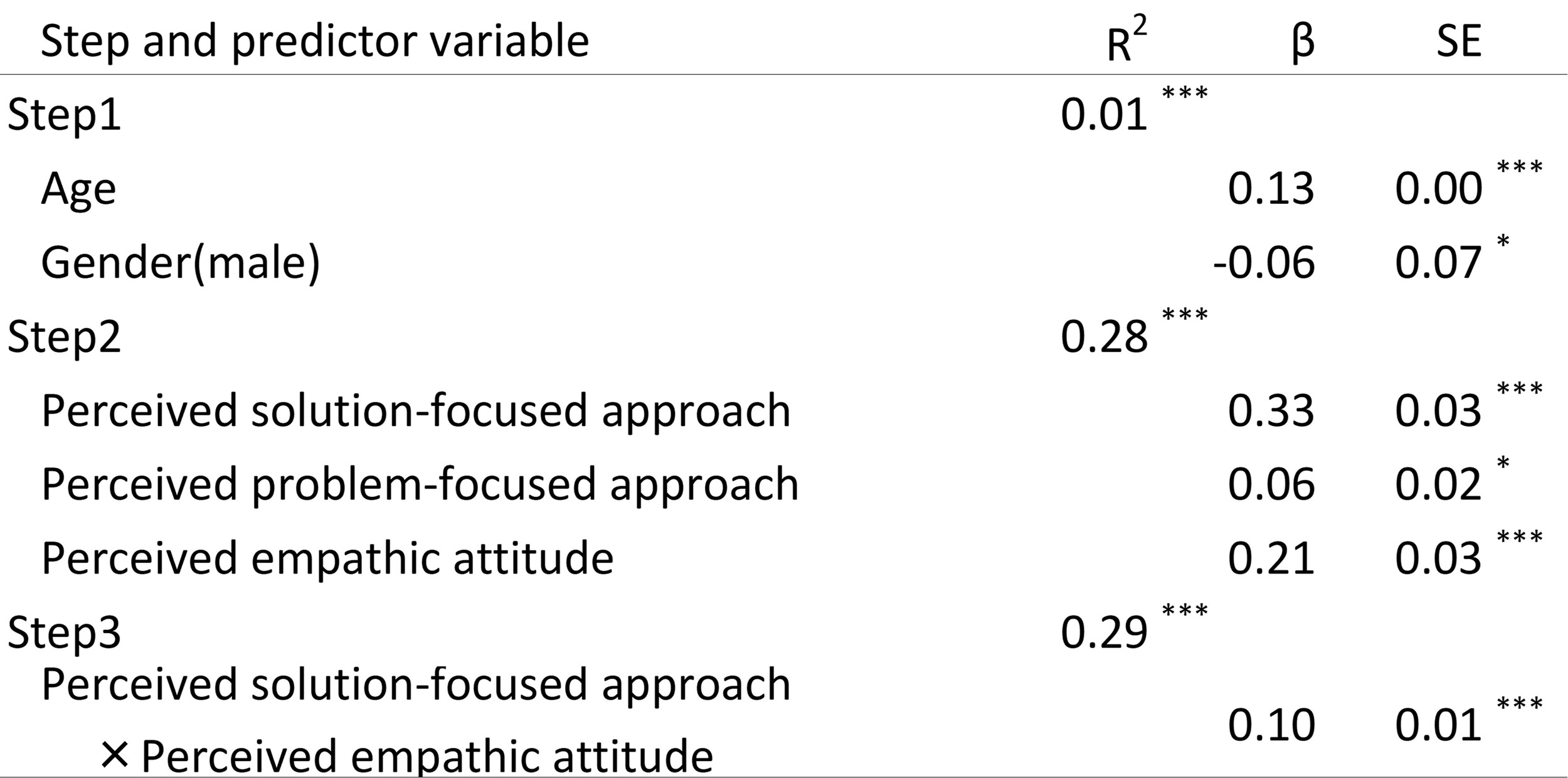
In Step 3, an interaction term between perceived solution-focused approach and perceived empathic attitudes was added to the model. The interaction term showed a significant positive association with work engagement (β = .10, p < .001), indicating that perceived empathic attitudes moderated the relationship between perceived solution-focused approach and employees’ work engagement. Age (β = .14, p < .001), perceived solution-focused approach (β = .32, p < .001), perceived problem-focused approach (β = .06, p = .015), and perceived empathic attitudes (β = .24, p < .001) also showed significant positive associations with work engagement. To further examine the nature of the interaction, simple slope analyses were conducted at the mean and at ±1 SD of perceived empathic attitudes. The results indicated that perceived solution-focused approach was positively associated with work engagement at low levels of perceived empathic attitudes (−1 SD: β = .25, p < .001), mean (β = .32, p < .001), and high levels of perceived empathic attitudes (+1 SD: β = .39, p < .001). Furthermore, the slope increased as perceived empathic attitudes increased.
Discussion
Summary of Findings
The present study aimed to examine how employees’ perceptions of supervisors’ communication orientations—specifically solution-focused and problem-focused approaches—and employee’s perception of supervisor’s empathic attitudes relate to employees’ work engagement among software engineers. Of the four hypotheses tested, the results supported Hypothesis 1, that employee’s perception of supervisor’s empathic attitudes positively predicts employees’ work engagement, as well as Hypothesis 2, that perceived solution-focused approach positively predicts employees’ work engagement. Hypothesis 4, that employee’s perception of supervisor’s empathic attitudes moderates (strengthens) the relationship between solution-focused approach and employees’ work engagement, was also supported. In addition, although supervisors’ problem-focused approach showed a statistically significant association with work engagement, the standardized coefficient was small (β = .06, p = .015), indicating a substantively limited effect relative to the other variables. This result is broadly consistent with Hypothesis 3, which posited that supervisors’ problem-focused approach would show a weak or non-significant association with employees’ work engagement.
Theoretical Implications
A key theoretical contribution of this study lies in extending the understanding of the role of job resources within the JD-R model. JD-R research has to date focused primarily on the direct effects of individual job resources on work engagement. In recent years, however, it has been suggested that multiple job resources may interact with one another in a complementary fashion, thereby amplifying the motivational process (Bakker et al., 2007, 2023; Demerouti & Bakker, 2023). That is, the effect of a given resource on motivation is expected to be amplified when other resources are also high (Demerouti & Bakker, 2023). The present study demonstrated that two resources—supervisors’ solution-focused approach, which seeks to explore and expand employees’ possibilities and strengths, and employee’s perception of supervisor’s empathic attitudes—interact to strengthen their association with employees’ work engagement. This finding supports the JD-R theoretical discussions concerning resource interactions and has theoretical significance in identifying the interactive nature of specific resources.
A further theoretical contribution of this study concerns the context of one-on-one meetings. Previous research has demonstrated that the frequency of one-on-one meetings is positively associated with employees’ work engagement (Furuta, 2023), suggesting that the quantity of such interactions matters for employee outcomes. The present study extends this line of inquiry by focusing on the quality of one-on-one meetings. Specifically, by examining supervisors’ solution-focused communication orientation as a qualitative aspect of one-on-one interactions, the findings suggest that not only how often supervisors meet with employees, but also how they communicate during those meetings, is associated with employees’ work engagement. These results highlight the role of one-on-one meetings as an interpersonal context in which the quality of supervisory communication may contribute to shaping employees’ motivational states.
Practical Implications
In practical terms, the present findings suggest guidance for supervisors seeking to enhance employees’ work engagement through their communication. The study demonstrated that the association between supervisors’ solution-focused approach and employees’ work engagement was stronger when combined with employee’s perception of supervisor’s empathic attitudes. Although the issue of clarifying causality remains, this suggests that it is not only important for supervisors to direct employees’ attention toward future possibilities, but that doing so in conjunction with employee’s perception of supervisor’s empathic attitudes—demonstrating understanding of employees’ experiences and emotions—is also critical. In managerial and human resource development practice, therefore, it may be effective to cultivate not only skills for identifying problems and providing directive guidance, but also an empathic attitude toward employees, including genuinely listening to employees and seeking to understand their emotions and circumstances, alongside solution-focused communication skills that orient attention toward employees’ future possibilities. Such a combined approach may enhance employees’ proactive engagement with and vitality toward their work.
Limitations and Future Directions
The present study has several limitations. First, while this study examined the association between supervisors’ solution-focused approach and work engagement with a primary focus on individual-level relationships, the organizational environment and situational context in which these relationships operate were not sufficiently considered. Recent research on leader–member exchange (LMX) suggests that the effects of supervisor–employee relationships may vary depending on contextual conditions (Bernerth et al., 2016). For example, the positive effects of high-quality relationships may be stronger in environments characterized by abundant resources and shared goals, and weaker in environments characterized by resource scarcity, uncertainty, or goal misalignment. As a result, the present findings may not fully capture contextual factors that could amplify or attenuate the observed associations between supervisory communication and work engagement. Accordingly, the generalizability of the findings to organizational settings characterized by high resource scarcity, goal misalignment, or environmental uncertainty should be interpreted with caution. Future research should examine these relationships within a broader contextual framework by incorporating factors such as organizational resource availability, task uncertainty, and the degree of goal sharing in order to better understand the conditions under which supervisors’ solution-focused approach contributes to employees’ work engagement.
Second, because the present study is based on cross-sectional data collected from the same respondents via self-report, several methodological limitations should be noted. First, since all variables were measured using self-report data from a single source, the results may be subject to common method bias (Podsakoff et al., 2003). To examine this possibility, Harman’s single-factor test (Podsakoff & Organ, 1986) was conducted. All items measuring work engagement, the supervisor’s solution-focused approach, the supervisor’s problem-focused approach, and the supervisor’s empathic attitude were entered into an exploratory factor analysis (maximum likelihood method, Promax rotation), which yielded four factors with eigenvalues greater than 1. The first factor accounted for 43.85% of the variance, indicating that a single factor did not account for the majority of the variance in the data; thus, the influence of common method bias in this study is likely limited. Second, because the data are cross-sectional, causal relationships among the variables cannot be firmly established. In work engagement research, the relationship between job resources and engagement is understood as a dynamic process in which the two mutually influence each other over time. For instance, JD-R research has shown that while job resources enhance engagement, employees with high engagement also acquire more resources, giving rise to a resource gain spiral (Bakker & Demerouti, 2007; Hakanen et al., 2008). Longitudinal research designs are therefore needed to examine such reciprocal processes and to disentangle the directionality of these relationships.
Third, in this analysis, we used a six-item solution-focused scale and a three-item problem-focused scale. Therefore, we cannot completely rule out the possibility that this imbalance in the number of items may have influenced the results. Future studies should employ scales that are more balanced and have smaller possibility of measurement errors.
Fourth, although this study was based on a survey of software engineers, it did not allow for an examination of the considerable diversity within this occupational group. Software development encompasses a wide range of roles, including requirements definition, design, implementation, testing, and operations, and the job demands and work conditions associated with these roles may differ substantially (Meyer et al., 2017). Furthermore, variations in team structure, project management approaches, and development methodologies may influence communication processes and the meaning attributed to supervisor–employee relationships. Accordingly, the association between supervisors’ solution-focused approach and employees’ work engagement may vary across different occupational specializations within software engineering. Therefore, the findings should be interpreted as reflecting the context of software engineers as a broad occupational category, and caution is warranted when generalizing the results to other industries, professions, or work settings. Future research should examine whether the observed relationships differ across job roles, development phases, team structures, and development methodologies in order to better understand the boundary conditions of the present findings.
Fifth, the present study has limitations with respect to the validity of the measures used. Two of the study-specific measures—the supervisors’ communication orientation scale (including the solution-focused and problem-focused subscales) and the employee’s perception of supervisor’s empathic attitudes scale—were developed specifically for the purposes of this study, and their convergent and discriminant validity were not examined. Although the factor structures of these measures were examined through exploratory factor analysis and supported the hypothesized structures, the absence of convergent and discriminant validity testing reduces confidence in the operationalization of the key constructs. Nevertheless, the associations observed among these measures were consistent in direction with the theoretical concepts on which the items were developed, providing some reassurance regarding their construct validity. Accordingly, the associations reported here should still be interpreted with some caution, as the observed relationships may partly reflect measurement limitations rather than the true relationships among the constructs. Future research should establish the convergent and discriminant validity of these measures to further strengthen their construct validity.
Sixth, all variables of interest in this study were measured exclusively from the employees’ perspective. Although employees’ perceptions are meaningful in that they reflect the subjective experience through which supervisory behavior translates into psychological and motivational outcomes, this approach does not capture supervisors’ own intentions, self-reported behaviors, or the extent to which their communication style was deliberately and purposefully enacted during supervision. It is possible that a discrepancy exists between supervisors’ actual communicative intent and employees’ perceptions of that communication, and such discrepancies were not examined in the present study. Future research should incorporate supervisors’ self-reports to enable a more multi-source, multi-perspective examination of the supervisor–employee communication process and its association with employees’ work engagement.
Conclusion
The present study examined the relationships among supervisors’ communication orientations, employee’s perception of supervisor’s empathic attitudes, and employees’ work engagement among software engineers in Japan. The findings showed that supervisors’ solution-focused communication orientation and employee’s perception of supervisor’s empathic attitudes were each positively associated with work engagement and interacted in predicting employees’ work engagement. These results suggest that solution-focused communication may be particularly effective when embedded within an empathic relational context, highlighting the value of combining future-oriented dialogue with a genuine understanding of employees’ experiences and emotions.
By extending solution-focused practices to organizational settings and situating them within the Job Demands–Resources (JD-R) framework, this study contributes to a better understanding of how the quality of supervisory communication in one-on-one meetings is associated with employees’ motivational states. The findings also offer practical implications for supervisors and organizations seeking to enhance employee engagement through interpersonal communication.