Research on Solution Focused Brief Therapy has predominantly focused on therapeutic outcomes, client experiences, and the effectiveness of interventions. Existing literature has contributed important insight into how clients experience Solution Focused Therapy and whether the approach contributes to positive therapeutic outcomes. However, less attention has been given to how therapists themselves describe and understand their own therapeutic practices, particularly female Solution Focused therapists. A research study by Cook et al. (2010) on what psychotherapists really do in practice found that the majority of clinicians described their work as eclectic but this study was an internet web-based questionnaire with 2200 North American psychotherapists concerning their clinical work and thus quantitative and not qualitative and the sample was a wide range of practitioners using different therapeutic modalities of which the Solution Focused approach was not one. Another study by Lindgren et al. (2012) examined what psychotherapists consider effective in their practice of psychotherapy. Nine psychotherapists with diverse theoretical approaches were interviewed, and the study focused more on the therapist’s own understanding of their practice rather than describing how they work. Yet another study, looked at the effects of sex and gender in ten types of psychotherapy approaches (Staczan et al., 2015) not only at the outcome, but also at the process of how the therapists intervene. Solution Focused Brief Therapy wasn’t one of the ten approaches examined either, however one of the findings was that there is a tendency for female therapists to be more empathetic in their interventions, and male therapists to be more confrontational.
Thus, studies focussing on how female therapists describe what they do in practice is limited and as De Guzman (2025) rightfully notes; that even though the predominance of women practitioners in psychology and counselling fields are high, research rarely focuses specifically on how female therapists describe what they do in practice. Most studies continue to prioritise professional identity and or effectiveness rather than detailed descriptions of therapeutic practice itself.
Some literature, however, suggests that gender may shape therapeutic style, relational positioning, and conversational practice. In Eve Lipchik’s reflections in Women’s Perspectives on the Solution Focused Approach’ (Wulf & von Cziffra-Bergs, 2024), she writes (p. x-xi):
The style of the Brief Family Therapy group members clearly differed. There is no question that Insoo, Marilyn and I were more conversational and warm with clients than the men were.
Even though Eve Lipchik’s observations might be close to half a century old, they still suggest that gendered dimensions of Solution Focused practice may exist, yet these dimensions remain largely unexplored in empirical research.
Within the Solution Focused literature, existing studies focus on different aspects of gender than the present research. For instance, an older study of Dermer, Hemesath, and Russell’s (1998) feminist critique of Solution Focused Therapy, examined how therapist neutrality risks reproducing patriarchal norms by insufficiently addressing broader social inequalities. Similarly, Yates et al. (2023), in research with women living with HIV, explored collaborative counselling practices and participation in therapeutic processes. While these studies engage gender related concerns, they do not investigate how female Solution Focused practitioners themselves describe and carry out their work, whether it’s in the field of therapy, counselling, coaching or social work.
An important development in this area was the publication of Women’s Perspectives on the Solution Focused Approach (Wulf & von Cziffra-Bergs, 2024), which brought together narratives from 17 women practicing in diverse cultural and professional contexts. The contributors reflected on how they worked from the Solution Focused Approach, how identity and gender shaped their practice, and how Solution Focused work varied contextually across settings. Importantly, however, the book was not designed as a research study but as a collection of narratives intended to share experiences among women practitioners from six continents.
The present study builds upon and revisits this material through a more rigorous qualitative research lens. Rather than retelling the narratives, this study closely explores the women’s written descriptions of practice through an analysis of the verbs and linguistic formulations used to describe behaviour and action. This specific subject area, namely the linguistic and descriptive analysis of how female Solution Focused practitioners describe their work, has not previously been researched.
Research into Solution Focused practice increasingly recognises that therapeutic work is fundamentally linguistic, relational, and interactional. Zatloukal and Wiesner (2021) state that Solution Focused practitioners operate through conversational practices such as questions, formulations, and presuppositions that shape clients’ understandings of problems and solutions. Despite this recognition, there remains limited qualitative research examining how therapists themselves describe these practices in their own words. Also, the qualitative research design of this study is a methodological contribution given the broader imbalance within Solution Focused research. A scoping review by Żak, Pakrosnis, and Kuminskaya (2023) found that most Solution Focused studies were quantitative, with only 10% employing qualitative methodologies and 17% using mixed methods approaches.
These gaps point to the need for qualitative research that centres female Solution Focused therapists’ descriptions of practice. Exploring how female practitioners describe and articulate what they do within their working contexts, can deepen understanding of the relational, contextual, and linguistic dimensions of Solution Focused work, while also contributing to a female therapist-centred perspective that remains largely absent within the existing literature.
FUNDAMENTAL PRINCIPLES OF THE SOLUTION FOCUSED APPROACH
The research study investigates language and actions within the Solution Focused Approach associated with the work of Steve de Shazer, Insoo Kim Berg along with contemporary global training institutes. The Solution Focused Approach is a collaborative approach that invites the client to reflect on what they want differently in their lives (King, 2021; Yusuf, 2021). The SFA is described as a co-constructive approach that builds descriptions of a preferred future (De Jong & Berg, 2002; McKergow, 2021). The language used by SF practitioners is carefully selected and often built on the client’s own words with the intention of amplifying client’s strength, resources and competences (De Jong et al., 2013b, p. 43).
It is also known that Solution Focused practitioners are trained to have a stance that promotes “natural collaboration” (McKiernan, 2021, p. 164) and is grounded in presuppositions and assumptions (Conniff, 2021; De Jong et al., 2013a; De Shazer et al., 2012), of which some can be summarized as follows:
-
Clients change and develop through focus on past successes, own resources and competences.
-
There is not necessarily a relation between a problem and a solution.
-
Small changes in one area can lead to greater changes in other areas of the client’s life.
-
The client is the expert of their own life and has inherent resources and potential.
-
No problems are constant; there are always exceptions to the problem.
-
The conversation is oriented towards the client’s preferred future, which can constantly change.
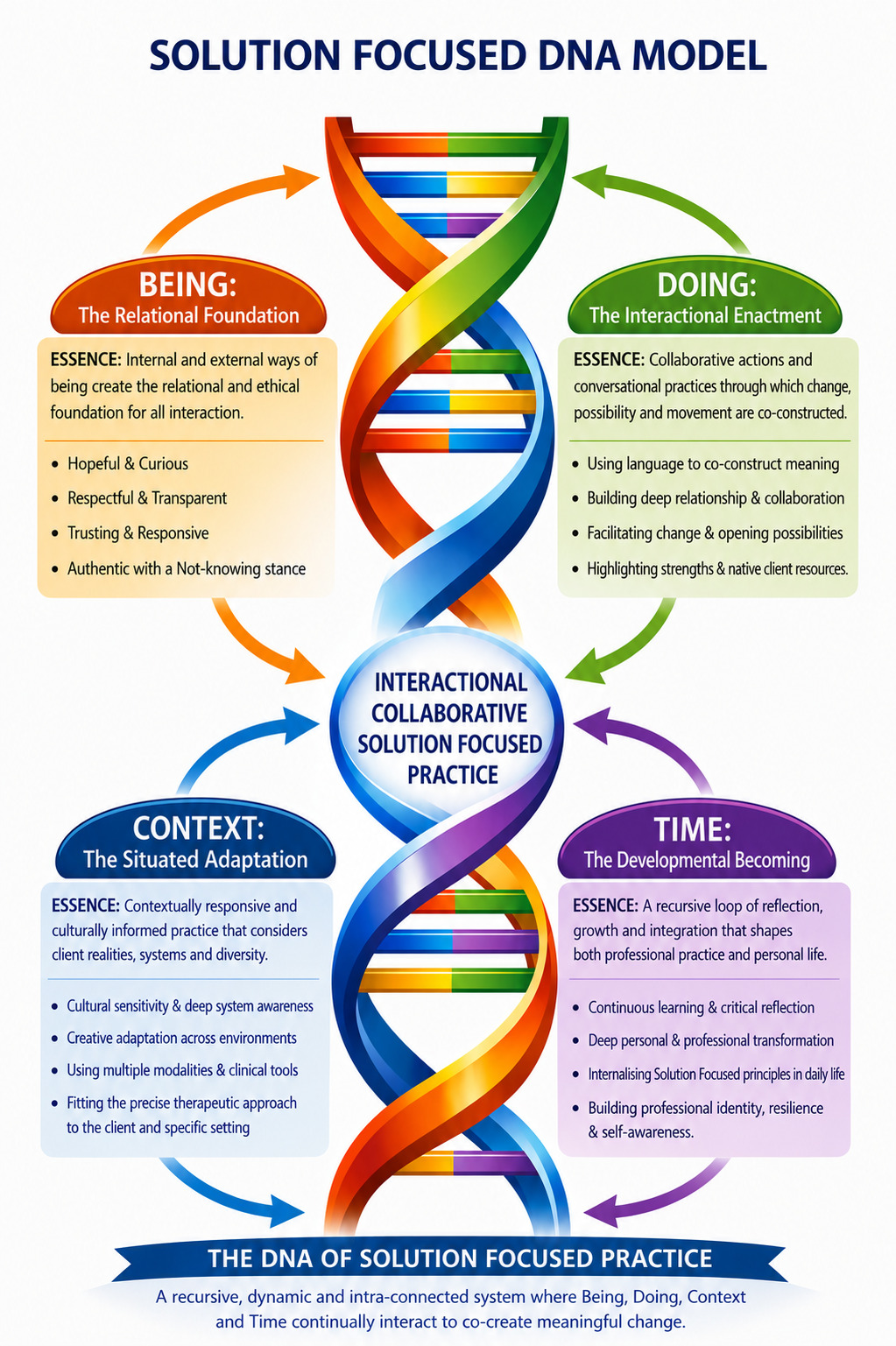
In Women’s Perspectives of the Solution Focused Approach (Wulf & von Cziffra-Bergs, 2024, p. 11) the concept of each practitioner having their own “Solution Focused DNA” was introduced. This concept consists of four dimensions namely your BEING, DOING, CONTEXT and TIME. Burgstaller and Iveson (2019) initiated this concept by proposing that effective Solution Focused practice depends on the integration of BEING (beliefs, assumptions, thinking, reflecting and presuppositions) and DOING (actions and behaviours that are observably grounded), emphasising that these two dimensions are mutually reinforcing and inseparable in practice. BEING refers to the practitioner’s orientation towards clients for example curiosity, respect, not-knowing stance), while DOING refers to observable conversational SF practices such as questioning, scaling, and highlighting resources.
In addition to BEING and DOING, Wulf and von Cziffra-Bergs suggested two more dimensions TIME and CONTEXT to the four parts that they called the Solution Focused DNA (2024, p. 11). The authors suggested that practitioners have their own cultural context within which they practice and live and has their own timeline of learning the Solution Focused Approach with different educational backgrounds, trainers and mentors. In addition to their assumptions and beliefs (Being) their CONTEXT and TIME set a direction for their actions and behaviour (Doing), and together they construct different strands in their unique Solution Focused DNA.
RESEARCH DESIGN AND METHOD
Based on the researcher’s curiosity and the already available data, it became relevant to formulate and ask the following research questions:
-
How do female Solution Focused practitioners describe their professional practice in written narratives?
-
What verbs do practitioners use to describe their actions, and what patterns arise within these linguistic constructions?
-
How do these linguistic patterns construct and reflect practitioners’ Being, Doing, Context and Time when applying the Solution Focused approach?
A qualitative research design was implemented allowing rich descriptions of female practitioners in their natural settings (Miles et al., 2014) and allowed for a deep engagement with the data. The data were analysed using a Reflexive Thematic Analysis (RTA) approach as outlined by Braun and Clarke (2021), which conceptualises theme development as an active and recursive process of meaning-making. As the data were collected from secondary data of written descriptions of practice rather than direct analysis of practice itself, Reflexive Thematic Analysis allowed the researchers to engage with the data and for themes to be actively generated through analytic interpretation (Braun & Clarke, 2006, 2019, 2021). Further, Reflexive Thematic Analysis (RTA) invited the researchers into a recursive process, making decisions and questioning themselves as Braun & Clarke (2019, p. 13) state:
“They (researchers) are aware of the need to make decisions around analysis, and they knowingly engage and make them. The coding process requires a continual bending back on oneself – questioning and querying the assumptions we are making in interpreting and coding the data.”
Analysing the data using RTA, themes were created in an active process of meaning making rather than a mechanical static coding procedure of topic making. Given the study’s focus on how 17 female Solution Focused therapists describe their practice, the analytical emphasis was placed on capturing action-oriented language within the data. The RTA process can be described as a movement from concrete data via coding to a recurring pattern of meaning and then into overarching themes. Reflexive Thematic Analysis assumes that researchers actively interpret meaning and develop themes through engagement with the material. Themes are not understood as objectively existing in the data, but as analytic constructions developed in relation to the material, the research questions, prior knowledge, and the researchers’ engagement. Themes are therefore understood as analytic constructions developed through deep engagement, reflexivity, and theoretical positioning and zooming in and out of the data (Braun & Clarke, 2021) which leans toward a hybrid of inductive-deductive thematic analysis.
Sample Selection
The sample was selected from all seventeen women from fifteen countries, co-authors of Women’s Perspectives of the Solution Focused approach (Wulf & von Cziffra-Bergs, 2024), and were originally selected as they represented diverse contexts such as trauma work, research, suicide prevention, education, mental health, organisational development, and community settings, and included different educational qualifications such as psychologists, psychiatrists, social workers, teachers, coaches and researchers to diversify the sample.
The sample consisted predominantly of participants with masters degrees (n=10), followed by Doctorate degrees (n=4), with fewer participants holding an education degree (n=2) and one participant who is a coach, but it is unknown what degree she holds (n=1). The participants selected, demonstrated substantial professional experience, with years of practice ranging from 10 to 38 years. All the participants had Solution Focused training and used the Solution Focused Approach in their daily practice. The sample’s experience in specifically Solution Focused Brief Therapy (SFBT) ranged from 8 to 30 years. The women were selected by the book editors to represent women from all continents making significant contributions in their field.
Data Collection
The data collection consisted of responses to the following four questions answered in Women’s Perspectives on the Solution Focused Approach (Routledge, 2024):
-
How does your gender influence your work life and being a Solution Focused practitioner?
- Asking about influences led to descriptions of practice as well as asking about BEING led to descriptions of beliefs and assumptions.
-
What would others notice you doing that would tell them that you work from a Solution Focused approach?
- Participants’ responses gave descriptions of DOING from a third person perspective.
-
Share an exercise that might be useful to other women practitioners.
- Participants’ responses shared a clear description of DOING in a first-person perspective.
-
How do you adapt the approach and make it your own? Give us five characteristics that are a part of your Solution Focused DNA.
- The answer to the above question allowed for descriptions of BEING, DOING, CONTEXT and TIME.
Analytical Method
The data were analysed by using Reflexive Thematic Analysis as described by Braun and Clarke (2019, 2021). This approach sees analysis as an active and interpretive process, where the researcher plays an important role in making meaning from the data collected. Rather than discovering themes that already exist, themes are constructed through ongoing engagement with the data. To keep the data analysis process transparent, trustworthy and valid, a 6-phase analysis process was followed (Braun & Clarke, n.d., 2021) with underlying steps. In the first two phases, the researchers engaged with the material individually. They then discussed their readings during the joint development of codes, categories and themes. The individual work was not intended to establish one correct interpretation, but to bring different readings into the subsequent shared analysis. Phases 3 to 6 were done together in reflexive discussions to ensure that Thematic Analysis remained reflexive and close to the participants’ descriptions and own language.
Phase 1 - Getting familiar with the data
Step 1: Data were collected secondarily from written descriptions of practice rather than direct analysis of practice itself. As the data were part of a book edited by the researchers, they were already familiar with the written narratives, but in a superficial way, and more than a year ago. To gain a deeper insight and immerse into the data and to become familiar with it, the narratives were read and re-read several times. This process was done individually by the researchers, each highlighting what stood out for her individually.
Step 2: Whilst becoming familiar with the data, the researchers noticed that the practitioners described their practice by using words related to actions and behaviour, thus active and action-oriented language.
Phase 2 - Generating initial Codes
Step 3: The written narratives were then prepared by putting 17 responses to Question 1 in one document. The same process was followed for the responses to question 2 - 4 (in Women’s Perspectives of the Solution Focused Approach (2024) framed as question 1, 3, 4 and 5). As there were four questions the data were kept in four documents. Attention was given to active- and action-oriented language (Step 2) and breaking down the data was done by systematically highlighting all the active and action-oriented words. Descriptions in the form of verbs came to the foreground as practitioners described their therapeutic practice.
Step 4: From breaking down the data, and highlighting the verbs, two aspects became obvious: verbs that referred to either Internal process or External actions. Internal processes indicated thinking and reflecting, often un-observable actions taking place in the practitioner’s mind, and External actions, showed actions and behaviours that could be observed and seen by others. The verbs in each document (Step 3) were coloured in either red (External) or blue (Internal) and further organised alphabetically with the corresponding raw data quote next to each.
At this stage the coding was still generated into four documents (Step 3) each having the same meaningful sequences: 1) identifying verbs in 17 responses to the same questions and 2) colour-coding the verbs in either blue (referring to internal process) or red (referring to external actions). This second phase was still done individually with follow-up online meetings to reflect, think, co-create and collaborate on meaning making. The coding process remained data-driven throughout this phase, with codes derived directly from practitioner descriptions rather than from predetermined theoretical constructs.
Phase 3 - Generating initial themes
Step 5: At this point the researchers met up and started comparing their separate lists of verbs coloured in either blue or red. The process gave rise to discussions and clarifications of what the researchers each understood by the verb and the context in which it was used. It became evident that verbs cannot be studied in isolation, but rather within the linguistic construction they are applied. To clarify: in the sentence "I always ask questions from a curious position so that the client can reflect on the changes he wants", you find three verbs used in mixed verb format with can as a main describing verb. The sentence is describing actions like Asking, Reflecting and Wanting, but two of the verbs relate to the effect of Asking, and therefore says nothing about what the practitioner is doing. The coding process of comparing and debating verbs resulted in creating one document alphabetically listing 129 verbs in two colours with an emphasis on verbs that describe practitioner’s actions.
Step 6: All 129 coded extracts were printed, and each code was physically cut into individual strips to facilitate active engagement with the data. The researchers reflexively examined each cut up coded strip by asking interpretive questions such as: What is the practitioner attempting to describe? and What underlying meaning or process does this sentence represent? In-line with Braun and Clarke’s reflexive approach (2019), the researchers acknowledge that theme development is inherently interpretive and subjective rather than objective. As both researchers are Solution Focused practitioners and the editors of the source text from which the data were drawn, the researchers recognised their professional proximity to the data and utilised this experiential knowledge as an analytic resource. Through this iterative and interpretive process, the data were organised into seven preliminary themes namely: Mindset, Stance, Language, Relationship and Collaboration, Signs of Solution Focused Practice, Techniques, and Personal Growth. Seven envelopes with the theme name on each were created, and the verb strips were stored into each envelope. Some of the verbs could be sorted into 2 themes for example “Reflecting” could be used in different contexts such as "reflecting back to the client" which is a sign of SF practice and "reflecting on my spiritual growth" which illustrates Personal Growth, thus two different types of doing described by one coded verb namely reflecting. This resulted in printing the verb twice and placing it into 2 envelopes.
Phase 4: Reviewing and refining themes
Step 7: Initially sorting the data into 7 envelopes gave structure to organize the vast volume of data, however the need to refine the themes was necessary to ensure that each theme was named correctly. The researchers revisited the enveloped themes using a Solution Focused interpretive lens, continually asking themselves what practitioners were fundamentally describing through their accounts of practice. A lengthy process of engaging with the data within each envelope also followed as the researchers reviewed the data and kept asking: What are the practitioners describing here? And how do we capture what the practitioners are telling us? Each envelope was continuously opened and each theme re-looked and reviewed to make sure that the practitioner’s description had been placed in the correct envelope and that the theme of the envelope aptly described what the practitioners said they were doing. Following this process the two envelopes, Mindset and Stance, were merged into one theme named Embodied Professional Stance, while Techniques was renamed Creativity and Innovation. Language, Relationship and Collaboration, Signs of Solution Focused Practice, and Personal Growth were retained for further analysis. This phase reflected the Reflexive Thematic Analytical position where researchers actively construct themes through interpretive engagement with patterns of meaning across the dataset.
Phase 5: Defining and naming themes
Step 8: Braun and Clarke (2019) emphasise that prolonged engagement with the data enables researchers to move beyond surface level description toward interpretive analysis of broader patterns of meaning. At this point in the analysis process the researchers started reflecting on how these initial seven themes answer and relate to the research questions. As the central focus of the study concerned descriptions of Solution Focused actions, the researchers increasingly identified intersections between the initial seven themes and the proposed conceptual framework of a Solution Focused DNA consisting of BEING, DOING, CONTEXT and TIME. Some of the themes showed a definite and clear relation to the SF DNA for example Signs of SF baseline practice was clearly a DOING, and Embodied Professional Stance was clearly BEING.
With this recursive process of re-examining themes, theory and research question; it became clear that all the verbs that described creativity and innovation were all descriptions of adapting to the CONTEXT of the client and renamed as CONTEXT. This confirmed the idea of CONTEXT being a part of the SF DNA. Re-examining the Personal Growth theme led to a deductive to inductive process where it was renamed as TIME as all the descriptions of Personal Growth explained the practitioner’s personal journey and development with the Solution Focused approach. Initially the idea of TIME and CONTEXT came about through discussions of the editors’ personal journey however the data was validating the existence of these dimensions and became progressively integrated into the analytic process.
Step 9: The final four dimensions, BEING, DOING, CONTEXT and TIME, were therefore developed through an iterative process situated at the intersection of data engagement, researchers experience, theoretical interpretation, and the research question. Collectively, these four dimensions of practice were understood to provide the most coherent and meaningful account of the dataset. The relational interplay between the original seven themes into four dimensions became particularly significant in understanding how practitioners described their practice. The movement from internal and external coding toward integrated thematic interpretation into four overall dimensions, revealed nuanced descriptions of an intra-connected relational process in Solution Focused practice.
Phase 6: Producing a written research report
Step 10: The final phase involved the analytic write-up of the findings, supported by the inclusion of raw data extracts to illustrate and substantiate each dimension. As the relational and interconnected nature of the dimensions became increasingly evident, the researchers developed a visual model to represent the systemic and dynamic relationships identified within the data. This model illustrates the intra-related dimensions of BEING, DOING, CONTEXT and TIME, and serves as a conceptual representation of the relational process underpinning practitioners’ descriptions of Solution Focused practice.
RESEARCH REPORT
The research explores the journey two researchers undertook from editing a book of written narratives to a rigorous research study of the narratives using Reflexive Thematic Analysis to analyse how women Solution Focused practitioners describe their practice. During the analysis, 129 verbs were organised and used in the process of developing 7 themes that became 4 dimensions of practice. In relation to the research questions and the pre-existing Solution Focused DNA framework, the dimensions were subjectively constructed by the researchers and should be seen as an expression of their current interpretation of the data.
Being
This dimension captures a variation of descriptions in which practitioners’ approach and reflect on their work through internal attitudes, assumptions and pre-suppositions, all grounded in the Solution Focused (SF) thinking and mindset. The dimension contains what practitioners are aware of, their personal qualities and stance toward their work and what they fundamentally believe in and strive to adhere to.
Practitioners’ BEING was reflected in codes such as I am Caring, Accepting, Understanding, Observant, and Hopeful, illustrated by statements such as “I care deeply about women” and “I am in awe of how talented, creative, and resourceful these women are.” Honesty, ethical awareness, and Self-awareness also emerged as key aspects of professional presence, shaping how practitioners understood and presented themselves in practice. As one practitioner noted, “I am honest about my competencies,” (verb: I am honest), highlighting transparency as part of respectful practice. Trust in the meaning of clients’ behaviour within their lived contexts was also evident, as reflected in the statements, “I trust that the client’s behaviour makes sense within their context” (verb: trusting) and “I trust what I do.”
Practitioners described being continually mindful of Choosing, while Adopting a non-judgmental and Empowering view of those they work with. This involved intentionally looking beyond deficit-based perceptions to see the person, as one participant stated: “I choose to see the person and not the prisoner” (verb: choosing). Participants also referred to mindful Decision-making, noting, “I make conscious decisions to counter the experience” (verb: making decisions). Internal presence further included a Solution Focused not-knowing stance, expressed in “I have a not knowing stance,” (verb: having) alongside Adaptation in practice, as reflected in “I am adapting how I approach the client” (verb: adapting).
Practitioners also emphasised Tuning into context and remaining Aware, as illustrated by the statements, “manoeuvring and tuning into the setting and context” and “always being aware of what is there.” Finally, participants expressed Curiosity about clients’ preferred directions, as reflected in: “I am curious about what they want” (verb: I am curious).
Analysis
Analysing descriptions of BEING indicated a holistic way of relating and acting, through which hope, respect, curiosity and responsiveness are lived-in practice rather than used as a technique. By delving into and processing the data, a picture emerged of how the female Solution Focused practitioners perceive themselves. They unanimously describe their stance of “being” (I am…) through active conscious choices in their practice through inseparable processes of curiosity, transparency, trust and responsiveness that continuously unfolds in any work-related interaction.
BEING is therefore not experienced as a passive inner attitude, but as an embodied attitude that actively shapes how practitioners listened, responded, positioned clients and were attuned to the conversations. Using very descriptive verbs, female practitioners described a professional inner-practice, a BEING with a high level of reflection and responsibility.
Doing
The practitioners described various ways of working, emphasising the use of language, how they use SF principles and how they collaborate and build relationships with their clients. The practitioners described their linguistic DOING as an active deliberate way of shaping and guiding conversations. Language is Used as an internal application toward change, as a deliberate and reflective self-conscious practice of their professional work, noting “I use an empowering language” (verb: using), “I speak about people’s strengths and successes and reminding them, that people do the best they can” (verb: speaking) and “I redefine the situation” (verb: redefining). The distinction between problem-talk and solution-talk was also emphasised, with one participant explaining, “I use language, knowing that the language used to problem talk differs from the language used to talk about solutions” (verb: using language).
The practitioners described DOING the Solution Focused Approach in their own unique ways, for example building a preferred future was described as Dwelling on visions of the future. Applying the Solution Focused approach was described as an embodied way of working that integrates external action with internal mindset. Internal applications were described as Listening, Noticing, and Identifying of outcomes: “I identify what the client wants” (verb: identifying). One participant described “listening with a constructive ear,” while another highlighted the relational aspect in “I listen with compassion” (verb: listening). Participants described actions in verbs like Attending, Creating distance between the problem and the solution and Focusing on indicators of progress, captured in statements such as, “I notice past success” and “I create a space between the problem and the person” and “I focus on every notion of success”.
Solution Focused fundamentals were actively described in external DOINGS as Connecting with clients’ resources and successes, noting “I connect to their resources”. Descriptions of applying the SFA was emphasised by Recognising and Honouring client strengths, Exploring best hopes, and Dwelling on the preferred future; “I dwell an especially long time on a detailed vision of the future”. One practitioner described Exploring clients’ aspirations for sessions, noting, “I explore best hopes for the session”. Practitioners also Invited clients to take an active role in developing solutions, one noted: “I invite clients to look at their hopes, abilities and goals” (verb: inviting). Asking Solution Focused questions, including the creative use of scaling questions, were described in many variations as external applications to promote action, “I scale frequently, sometimes in creative ways”, “I ask them what they think needs to change” and “I’m asking the client to imagine”, “I’m asking clients to focus on their hopes” and “I’m asking to name a superpower”.
Participants described how they were Collaborating with their clients. Descriptions of collaboration were evident and aligned with the Solution Focused framework. Building relationships and collaboration was described as an intentional practice to enhance co-operation and engagement. Descriptions of Establishing trusting relationships and becoming emotionally attuned was noted in “I establish a trusting relationship” and “I establish emotional connections”. Practitioners emphasized applying a relational quality with demonstrating commitment to support client’s autonomy by Choosing a sense of humanity and dignity for example “I choose to call them by their given name”. Modelling appropriate relational boundaries and interactions was also described in “I am fostering and modelling what appropriate relationships with boundaries and interactions with women should look like.”
Descriptions of external applications were related to actively Co-constructing solutions where practitioners noted, “I immediately co-construct with them when they share exceptions.” Further highlighted were strategies that Encourage interaction, one noted: “I encourage interaction”. Supporting clients to notice their resources was central to building relationships for example “I support them in bringing all the resources they have to the fore and making these available again.”
Analysis
The dimension of DOING illustrated how therapeutic actions became enacted through language, collaboration and change oriented practices. Practitioners described their DOING as a process of co-constructing meaning and possibility through Solution Focused conversations and intentional relationship building. Language functioned as a transformative relational action through which practitioners shaped attention, reconstructed narratives, amplified strengths, and facilitated preferred futures. Language was described as both a reflective and deliberate transformative action. Language therefore functioned not only as communication, but as a relational and co-constructive process through which meaning, identity, and change were actively and deliberately created.
DOING was further described as applying the fundamentals of the Solution Focused Approach in an individualised and personalised way. Solution Focused principles were used not only as shifting conversations, but also as an internal guidance system of directing what practitioners think, notice and listen for. These descriptions reflect an embodied way of doing Solution Focused practice. Relationship building and collaboration emerged as active processes through which trust, dignity, emotional safety, and shared participation enabled change to occur. Across the data, relationship building and collaboration emerged as a foundational participatory, and co-constructive process that shapes how practitioners positioned themselves in relation to clients. Solution Focused change was described not as a discrete model of intervention, but as a layered and evolving process involving noticing, amplifying, separating problems from identity, constructing futures, and collaboratively generating action.
Context
Practitioners described how they worked as deeply shaped by the CONTEXTS within which they work. They described the application of the SF approach as an adaptive, situated, and creatively responsive process influenced by cultural, professional and relational environments. Practice was described as evolving through interaction with diverse client needs, practitioner identities, sensory awareness, available resources, and contextual realities. Actions therefore extended beyond verbal conversation into embodied noticing, creative integration, experiential engagement, and the intentional shaping of relational environments. CONTEXT describes how practitioners adapted language, tools, and their work to the client and to the conditions in which practice took place.
Participants described how they used their competencies and knowledge to serve the client by Noticing subtle shifts in client behaviour, Exploring multisensory approaches and Developing “my own way of integrating” which describes how they adjust to the client’s context. One participant observed, “Noticing subtle changes in posture and breathing” highlighting sensitivity to small but meaningful indicators of client engagement and progress. Practitioners also emphasised Offering multiple sensory modalities, reflecting the understanding that solutions can be experienced beyond talk stating, “I offer more than talk as solutions can be experienced by all the senses.”
Flexibility in practice was described as one practitioner mentioned, “I am flexibly matching techniques to the person”. The creation of open and receptive environments was seen as foundational to fostering flexibility as illustrated in the statement, “I create an open and receptive environment” and “I am flexible, gentle and selfless like water.”
Incorporating tools, techniques, and experiential approaches to facilitate client engagement within their contextual setting was noted by Combining Solution Focused exercises with a range of creative and sensory strategies. One participant stated, “I am combining SF exercises with an experiential toolkit,” while another noted, “I am using humour or diagrams to facilitate exercises”. The CONTEXT informed practice using visual tools and interactive methods for example: “I remind clients by using a visual reminder,” and “I incorporate games”. The Use of other techniques derived from complementary approaches was also described in the statements, “I use other techniques derived from other approaches” and “I am an eclectic therapist who works from a SF framework” to tailor make the approach to suit the client’s context.
Practitioners described Incorporating exercises and tasks to support client reflection on progress, noticing successes, and exploring solutions creatively, as captured in the statements, “I use exercises and tasks encouraging clients to notice their successes,” and “I use metaphors and externalization.”
Analysis
Solution Focused practitioners describe working contextually and adapting creatively within the client’s environment. Internally, practitioners stayed aware of embodied, sensory, and contextual dimensions of change. Externally they adapted their process through creativity, multimodal engagement, and relational flexibility. Practice was therefore described not as the delivery of standardised interventions, but as a responsive and evolving practice shaped by client needs, practitioner identity, relational dynamics, and contextual settings.
Across the data, CONTEXT emerged as both an influence on practice and an active resource through which change processes were facilitated. Practitioners were not merely applying techniques within environments, but collaboratively constructing therapeutic spaces that allowed for flexibility, experiential engagement, sensory awareness, and personalised pathways toward change. The theme alludes to a higher order understanding of Solution Focused practice as contextually responsive action, in which therapeutic work is continuously adapted, embodied, and creatively co-constructed within the realities of diverse human experience and the boundaries of SF principles.
Time
Practitioners described Solution Focused practice as unfolding over time through ongoing processes of learning, reflection, personal transformation and lived application. They described Solution Focused practice not only as a professional framework, but as a recursive and developmental process that shaped their internal dialogue, self-understanding, relationships, and everyday ways of being. TIME was therefore not experienced merely as a chronological progression or professional experience, but as a continuous process through which Solution Focused principles became internalised, embodied, and integrated into practitioners’ identities and lives, resulting in personal growth.
Participants described personal growth over time as deeply shaped by Engagement with Solution Focused (SF) practices, which Fostered self-questioning, Journaling, Reframing and Imagining desired outcomes in their own lives. Practitioners highlighted Deliberate attention to personal goals and the Development of self-awareness, resilience, adaptability, optimism, and a proactive learning mindset, describing SF practice being used as both a professional and personal tool for transformation.
Internal Transformation and Embracing was described through reflective practices and self-coaching, one stated, “SF has transformed my own life activities,” while another said, “I embrace my inner strength”. Regular self-reflection by Asking questions that lead to personal development were described and captured in the statements: “I ask myself scaling questions” and “I ask myself how I want things to be different”.
The practitioners reported a change in their internal dialogue supporting ongoing personal growth and improvement, noting “SF practice has become part of every step of my internal dialogue. I have better conversations including my own self-talk”, “SF has helped me become the best version of myself” (verb: I have become) and “I have transferred some of my resilience and optimism that I have learnt from my clients to my children” (verb: I have transferred).
Analysis
This dimension illustrates that practitioners describe TIME as a recursive and transformative dimension of Solution Focused practice in which professional learning, personal development, and lived application continuously influence one another. Internally, practitioners described integrating Solution Focused principles into self-reflection, emotional resilience, identity development, and internal dialogue, while externally these principles extended into relationships, parenting, communication, and everyday decision-making. Solution Focused practice was therefore not described solely as a professional framework for therapeutic intervention, but as an evolving way of thinking, relating, and being in the world where professional practice and personal becoming are dynamically intertwined through continuous reflection, lived experience, and relational application.
DISCUSSION
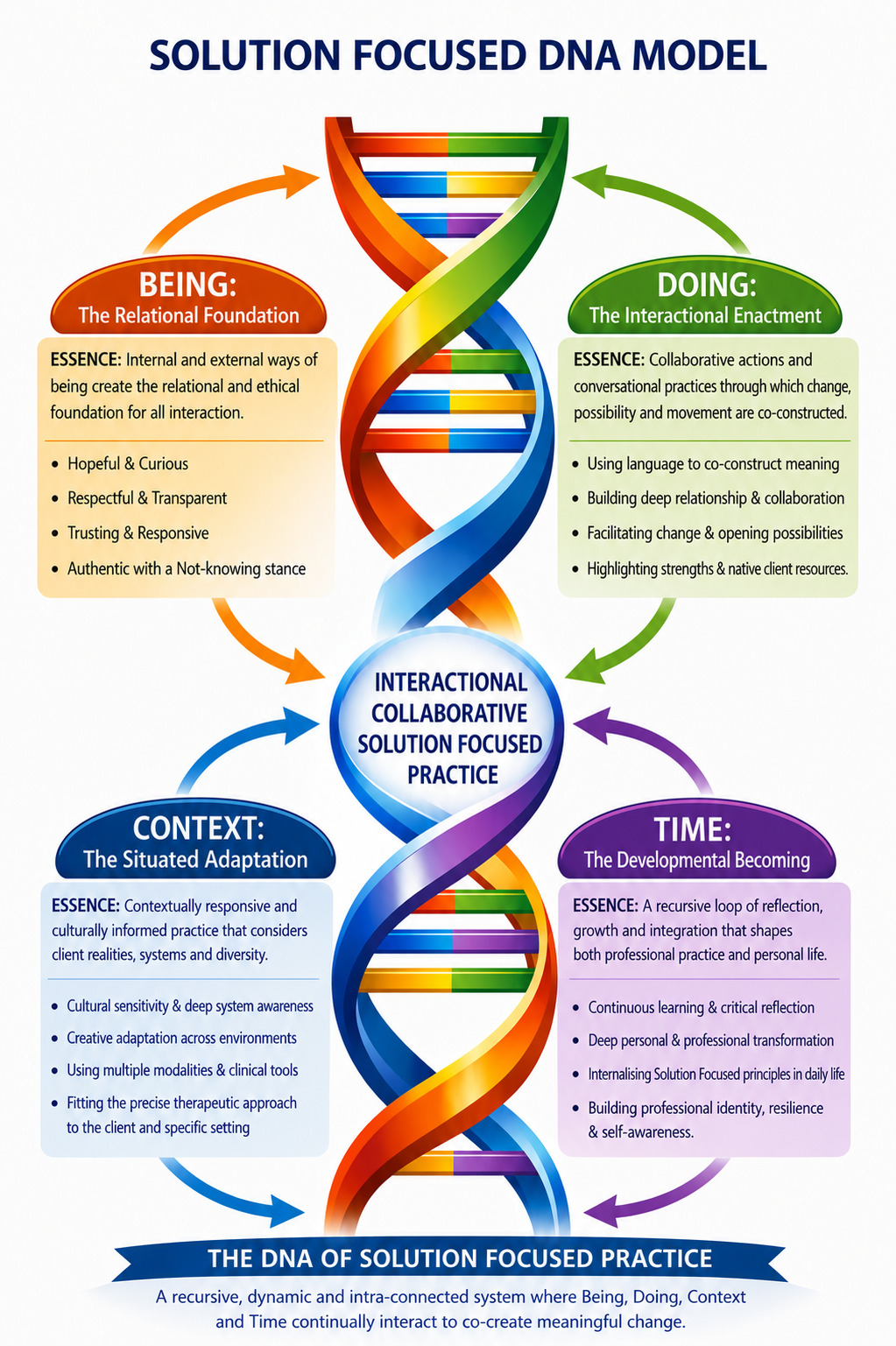
The four overall dimensions of practice in this study are based on the written narratives of 17 women and offer an interpretive conceptualisation of Solution Focused practice as a dynamic, relational, and recursively constructed process that extends beyond previous descriptions. The SF Approach is a lived and embodied professional orientation describing what Lipchik termed as ‘non-formulaic and mechanical’ (2002, p. 282). Across the data, practitioners described their Solution Focused practice not as a fixed method or procedural intervention model, but as an inter- and intra-connected way of being, relating, interacting, adapting, and becoming. The practitioners described their Solution Focused practice as simultaneously integrated, interactional, developmental and contextually situated. The Solution Focused DNA Model (fig.1) is an interpretive conceptualisation of how a group of practitioners described the intra-connected process between the dimensions of BEING, DOING, CONTEXT, and TIME. It is not presented as an empirically validated account of Solution Focused practice as a whole.
Collectively, the Solution Focused DNA model illustrates a conceptual understanding of SF practice as a recursive relational process in which the dimensions of BEING, DOING, CONTEXT and TIME continuously interact, interweave, impact and influence one another.
Rather than looking at BEING, and DOING separately, the SF DNA model includes the dimensions of TIME and CONTEXT showing the interaction between each other, as well as the intra-connection between them. Thus, the ability to act in each of them emerges from the relationship between them. This shift from inter-action to intra-action is described by Karen Barad (Juelskjær & Schwennesen, 2012, p. 23) when she states;
"These ideas are not in my head, rather they are specific ongoing reconfiguring’s of the world in its iterative intra-activity. These ideas are not outside or inside me, they are threaded through “me” and “me” through them, or rather we are threaded through one another."
The Solution Focused DNA Model (fig.1) captures the four dimensions not as separate themes, but as intra-connected processes through which SF practice is shaped, embodied, enacted, adapted, and developed over time, reiterating what Selekman calls “the wise therapist” (2024, p. 24).
The findings conclude that Solution Focused practice is far more than a collection of techniques or a method of intervention. Instead, SF practice emerges as an embodied, collaborative, contextually responsive, and developmentally evolving way of engaging with people and oneself. Therapeutic conversations become relational spaces through which meaning, identity, hope, agency, and possibility are continuously co-constructed. Across the data, practitioners were not merely describing what they do in therapy, but how they live, embody, adapt, and relationally enact Solution Focused principles within the complexity of human interaction and experience.
LIMITATIONS
An obvious limitation is that the dataset was derived from an existing published source of practitioner-generated descriptions, rather than being generated specifically for this study. As a result, the data were not originally produced in response to the research questions guiding the present analysis. This introduces a level of analytic constraint, as the form, depth, and focus of participants’ descriptions were shaped by the aims, prompts, and contextual framing of the original book. However, as the participants were writing personal narratives and not answering a research question lead to the data being very authentic, candid and forthright.
Another possible limitation lies in that one of the source questions referred directly to the Solution Focused DNA model. This may have oriented some participants’ responses toward meanings associated with that concept.
As the researchers are both women, both practicing Solution Focused practitioners and both Western women this could create potential bias in the analysis process, however Reflective Thematic Analysis utilizes researcher proximity to the data as an analytical resource.
CONTRIBUTIONS
The study makes several distinctive contributions that conceptualise SFA as an embodied, recursive, relational process of practice.
1. Reconceptualising the Solution Focused Approach as a Relational Process
The study contributes to a more holistic and process-oriented understanding of Solution Focused practice in which therapeutic action emerges through the interaction between practitioner stance, relational engagement, contextual responsiveness, and collaborative meaning-making, whilst using Solution Focused principles throughout their work. The study demonstrates that female practitioners describe Solution Focused practice as fundamentally grounded in ways of being, relational positioning, ethical responsiveness, and embodied interaction.
2. Development of the “Solution Focused DNA Model”
The development of the Solution Focused DNA Model represents a significant conceptual contribution. The model integrates:
-
Being (relational stance),
-
Doing (interactional practice),
-
Time (developmental becoming),
-
Context (situated responsiveness)
into a recursive and intra-connected process. This moves beyond not only a linear, but also a systems-oriented way of looking at and doing Solution Focused work. The SF DNA model offers an intra-connected and relational framework of understanding Solution Focused Practice. Yusuf (2021, p. 6) writes that there is a need for different explorations and adaptations of practice in the Solution Focused world and that from these new “seeds” will help the model grow in different directions. This study answers to Yusuf’ call and shares new ideas and seeds.
3. Positioning BEING as Foundational of SF Practice
This finding indicates that participants viewed the practitioner’s way of being as a foundational element in the therapeutic enactment of the Solution Focused approach, extending beyond the application of techniques alone. Hope, curiosity, attunement, respect, transparency, trust, and a not-knowing stance are embedded and shape every aspect of practice. A shift from what we do, to how we embody the approach. George (2021, p. 60) writes that a Solution Focused mindset “embodies a stance toward the client” however the research finds that BEING is foundational.
4. Recursive Practitioner Transformation as an Integrated Process.
The TIME dimension of the SF DNA model contributes a particularly novel insight by showing how Solution Focused practice over time becomes internalised within the practitioner’s life. The study finds that practitioners are not only facilitators of change but are transformed themselves through ongoing engagement with Solution Focused principles. The findings therefore contribute an understanding of Solution Focused practice as a developmental and identity-shaping process, not only for clients but for practitioners as well. Froerer et al (2018) allude to this finding by stating that working from a Solution Focused approach has a positive impact on the practitioner and they mention that practitioners become more vicariously resilient. Teri Pichot (2026) also talks about the 3 levels of Solution Focused integration, namely that practitioners start off only using SF techniques, then progress to the next level where their whole professional life becomes Solution Focused and then progresses into not only professional but personal life becomes solution focused. Finally in the systematic review of the impact the Solution Focused Practice has on workplace wellbeing, Garvey et. all (2026, p. 10) concludes:
“Following the training, those who implemented SFP into their work found wellbeing benefits such as improved connections with clients and colleagues, an alignment with their professional and personal values, and feelings of increased motivation, energy, job satisfaction, and reduced burnout.”
5. Solution Focused practice is Contextually Adaptive
The CONTEXT dimension in the SF DNA model contributes to the understanding of Solution Focused practice, being contextually adaptable rather than universally standardised. Practitioners described creatively adapting practice according to culture, systems, sensory engagement, relational environments and client realities. Pamela King (2021, p. 19) alludes to the idea that an 'element of a game increases engagement" when working with children and Dr Harriet Conniff (2021, p. 114) who works in a hospital with hospitalized clients uses creative metaphors by inserting a “quick Solution Focused injection”. This emphasises that without a context, words and action have no meaning.
6. Contribution to Reflexive Thematic Analysis and Qualitative Inquiry
Methodologically, the study demonstrates the value of Reflexive Thematic Analysis for exploring descriptions of practitioners’ experience within psychotherapy research. Rather than reducing practice to behavioural categories, the analysis captures:
-
relational processes,
-
embodied experience,
-
practitioner flexibility,
-
researcher engagement.
The study therefore contributes to a richly interpretive and integrated qualitative understanding of Solution Focused practice and research analysis.
7. Contribution to Female Practitioner Perspectives in Solution Focused Practice
Given the focus of the study on female Solution Focused practitioners the study contributes to an under-represented perspective within psychotherapy literature. The study puts women’s descriptions of practice in the foreground and gives voice to unknown female practitioners, thus deepening our understanding of how Solution Focused practitioners’ work.
In conclusion the researchers encourage further investigation of the intra-connectedness of BEING, DOING, CONTEXT and TIME that shape the Solution Focused Approach. Teaching and training of the relational factor of BEING, that plays a foundational role in female Solution Focused practitioners’ interaction and practice, is also encouraged.