“If men define situations as real, they are real in their consequences” (Thomas & Thomas, 1928, p. 572).
Clinical placements are important sites of professional learning in undergraduate nursing education. Students learn how to perform clinical tasks, communicate with patients, and apply theoretical knowledge. Alongside these clinical aspects, they learn to participate in a team, respond to feedback, and develop a sense of professional identity. The quality of supervision during clinical placements is therefore crucial. Effective supervision creates a supportive learning environment, facilitates students’ individual learning processes, and contributes to the development of their professional competence and identity (Jokelainen et al., 2011).
In these conversations, students, supervisors, mentors, and clinical teams often use broad expressions such as ‘letting go’, ‘perfectionist’, ‘not assertive’, ‘closeness and distance’, or ‘knowing one’s place as a student’. These expressions may be useful because they summarise complex experiences quickly. Yet they can also conceal important differences in meaning. After all, what’s in a name? Johnson (2004) captures this tension succinctly: “We live in a world of ever-changing uniqueness that we map by using a language of static categories; therefore, we have many opportunities for missed communication and misunderstanding” (p. 9). In clinical placement supervision, such static categories may become particularly consequential when a description of behaviour begins to function as a description of the student.
Let us take this to its absurd extreme. Imagine a supervisor or mentor responding to a label used by a student for self-description by applying another (potentially pejorative) label. For example:
-
Student: “I know what you are thinking… That I’m a perfectionist…”
-
Mentor: “Well, we have some problems here… You have ‘thinking errors’, such as ‘mind reading’ and ‘all-or-nothing thinking’. If this continues, you may even be putting yourself at risk of burnout.”
One might wonder what sense this deficit-focused dialogue makes without jointly exploring what these expressions mean and how, in de Shazer’s (1991) sense, they might usefully be creatively misunderstood together, particularly since de Shazer argues that “misunderstanding . . . is much more likely than understanding” (p. 69). Alongside this, what potential strengths may remain unexplored within the characteristics so readily named?
A student who says, “I am a perfectionist,” may be referring to careful preparation, fear of making mistakes, uncertainty about assessment, a need for reassurance, or a strong commitment to safe practice. A comparable ambiguity can arise when a mentor says that a student needs to pay attention to ‘closeness and distance’. This may refer to confidentiality, emotional over-responsibility, uncertainty about team norms, or an unspoken expectation about hierarchy. The same expression may therefore carry different meanings, values, and consequences for different participants in a placement conversation.
Labels may offer a convenient way of naming a (seemingly) complex issue, giving us a sense of control and shared recognition, and may point towards something important, but their apparent familiarity should not exempt them from being examined, specified, and related to the particular context. After all, giving a phenomenon a label does not yet explain what is happening, what matters to the student, or what would support further learning. When broad terms are treated as self-evident, students, supervisors, mentors, and teams may find it difficult to question them, contextualise them, or translate them into practical next steps.
This matters because feedback language can influence how students understand a particular event and how they understand themselves as future professionals. There is no such thing as ‘neutral’ information. Maturana and Varela (1987) argue that information is not simply transmitted and decoded in an identical way by different individuals. Rather, what is perceived and understood is shaped by the individual’s own structure and history of interactions. From this perspective, feedback is not merely transferred from one person to another, but interpreted and co-constructed in dialogue (Bavelas et al., 2014) within supervisory relationships. In clinical placement supervision, such interactions may contribute to students’ developing professional identity by shaping what they notice about their competence, role, and possibilities for action (Toh et al., 2022).
This article explores how solution-focused (SF) clinical placement supervision and mentorship can respond to such language without compromising clear feedback, minimum standards, professional boundaries, or assessment. The aim is not to determine whether a label is correct, nor to replace it with a more acceptable term. Instead, the article illustrates how supervisors and mentors—hereafter abbreviated as ‘S/Ms’—can become curious about what a word means in a particular situation, how it relates to observable actions, what purpose it may serve, and what the student would prefer to do differently.
Conceptually, the article draws on two closely related and historically interconnected traditions within SF practice: the Milwaukee tradition associated with de Shazer, Berg, and colleagues, and the Bruges Model, which emerged from the collaborative work of the Bruges Group, with important exchange and cross-fertilisation between the two traditions (de Shazer & Isebaert, 2004; Isebaert & Cabié, 1997).
Four constructed composite vignettes are used to examine this SF-informed process of unpacking broad professional labels in clinical placement supervision. Each vignette concerns a familiar professional expression that risks becoming a shortcut for a more complex emotional, relational, or educational issue. Together, they show how a supervisory conversation may move from broad labels towards contextualised descriptions, existing competencies, and co-constructed next steps.
Language Matters: A Solution-Focused Framework for Supervisory Dialogue
“We do not realize what tremendous power the structure of an habitual language has. It is not an exaggeration to say that it enslaves us through the mechanism of s.r. [semantic reactions], and that the structure which a language exhibits, and impresses upon us unconsciously, is automatically projected upon the world around us.” (Korzybski, 1933, p. 90)
Korzybski’s observation captures a central concern of this article: habitual ways of speaking may come to be experienced as properties of the world—and, in clinical placement supervision, as properties of the student.
This article is primarily grounded in an SF understanding of language as interactional and co-constructed. This perspective builds on a broader tradition in which language is understood as shaping, rather than simply representing, experience, from Korzybski’s (1933) general semantics and Wittgenstein’s (1953) philosophy of language to early analyses of therapeutic language by Bandler and Grinder (1975). SF practice emerged from a combination of systemic, semantic, pragmatic, and Ericksonian influences, alongside Wittgenstein’s philosophy of language. These influences are reflected in both the Milwaukee tradition and the Bruges Model. De Shazer and Berg (1992) explicitly articulated a post-structural understanding of therapeutic dialogue informed by Wittgenstein. The Bruges Model drew on related philosophical foundations and was strongly influenced by Korzybskian semantics, emphasizing that the discovery that one can make choices enhances a sense of control over one’s life (de Shazer & Isebaert, 2004; Isebaert, 2007, 2016; Isebaert & Cabié, 1997).
Accordingly, expressions such as ‘letting go’, ‘perfectionist’, ‘not assertive’, ‘closeness and distance’, or ‘knowing one’s place as a student’ are “simply constructions of the users of those terms” (de Shazer, 1994, p. 9). Drawing on the post-structuralist epistemological assumption that words are all we have, SF practice therefore attends closely to what is said and develops its meanings and possibilities through dialogue. From a Wittgensteinian perspective, this attention to words remains situated within lived experience, as words acquire meaning through their use in actions, relationships, circumstances, and shared practices. What a student says is thus approached as part of what the student is doing and experiencing within that particular interaction. As de Shazer (1991) argues, “there is no need to look behind or beneath since everything you need is already available and open to view” (p. 73). In clinical placement supervision, this means that language does not simply describe an already given reality.
The words chosen by a student, mentor, or supervisor shape what others notice, ask, and expect next, while these interactions in turn shape how the situation is understood and described.
Drawing on Wittgenstein, de Shazer (1994) captured this circular relationship by noting that “we need to look at how we have ordered the world in our language and how our language (which comes before us) has ordered our world” (p. 9).
A self-reported statement by a student, such as “I am never assertive,” may therefore be less useful as a stable description of the student’s personality than as an invitation to explore what the student means, in which situations this feels true, and whether there are moments that do not fit the description. As de Shazer (1991) noted, “We can only know what a word means by how the participants in the conversation use it” (p. 69).
This perspective is consistent with Wittgenstein’s later philosophy, particularly his view in Philosophical Investigations (1953) that “the meaning of a word is its use in the language” (§43). In the same work, his call for “description alone” to take the place of explanation (§109) is especially relevant in clinical placement supervision and mentorship. S/Ms can keep the conversation close to the event by eliciting a detailed description of the student’s actions and experience: what the student did, noticed, hoped for, or found difficult in a particular situation. This emphasis on description differs from Bandler and Grinder’s (1975) account of surface and deep structure. Their account drew on Chomsky’s (1965) theoretically posited deep structure, which should not be treated as evidence of a fuller psychological reality hidden beneath a speaker’s actual words. Their Meta Model sought to examine how a speaker’s surface structure related to an assumed fuller linguistic representation or deep structure. The present article makes a more modest, Wittgensteinian claim: rather than inferring an underlying trait or hidden cause, supervisors and mentors can examine how a particular expression is being used and how it relates to the student’s actions and experience in that situation.
Building on Wittgenstein, Drury (2014) argues that “we don’t obtain our understanding by inferences and deductions (intellectual activities) but via learned shared semiotic (meaning-making) activities” (p. 5). Research on dialogue similarly suggests that meaning is collaboratively achieved between interlocutors (Bavelas et al., 2014). In clinical placement supervision, this means that the words chosen by a student, mentor, or supervisor shape what others notice, ask, and expect next. The conversation therefore does not merely uncover meaning that was already present. Each question, response, reformulation, and acknowledgement participates in shaping what an expression can come to mean and what becomes possible next. Supervisor, mentor, and student are therefore not positioned outside language as neutral observers; they are mutually involved in the moment-by-moment production of the account they develop together.
Korzybski’s (1933) reminder that “a map is not the territory it represents” (p. 58) offers a related caution.
Feedback language may be well intended and grounded in genuine observations, but it can never fully represent the reality it seeks to describe.
Professional labels warrant further exploration before conclusions are drawn about competence, motivation, or identity. Korzybski (1933) also warned against the “is of identity”, through which an abstraction may come to be treated as a defining characteristic of a person. A related risk is what Keeney (1983), drawing on Alfred North Whitehead, describes as the ‘fallacy of misplaced concreteness’: abstracting relational processes and subsequently treating them as concrete objects with fixed characteristics. Thus, saying, “This student is (indeed) a perfectionist” can, in terms of general semantics, be understood as “equating a map with the territory” (Johnson, 2004, p. 8), risking both reducing the person to the problem and inducing a self-fulfilling prophecy of the undesired kind.
Taken together, these considerations invite a process of deconstruction. S/Ms can explore the interpretative assumptions embedded in apparently self-evident professional terms. A label such as ‘perfectionist’, ‘not assertive’, or ‘knowing one’s place as a student’ may appear to explain a learning issue while concealing different experiences, expectations, and relational meanings. Adopting a not-knowing stance (Anderson & Goolishian, 1992) enables the S/M to inquire into what is being taken for granted and whose interpretation is being privileged. In de Shazer’s terms, such inquiry involves a deconstruction process, which he describes as “developing doubts about global frames” (de Shazer, 1988, p. 101). This makes the meaning, basis, and practical implications of a label open to collaborative examination before it becomes a static conclusion about the student.
Within an SF orientation, this inquiry focuses on variations, exceptions, existing resources, and preferred developments rather than taking deficits or problem explanations as its primary point of departure (e.g., de Shazer, 1985, 1988, 1991, 1994; de Shazer & Isebaert, 2004; Isebaert, 2007, 2016; Isebaert & Cabié, 1997). The supervisor or mentor may ask what a term means to the student, how it shows up in a specific situation, when it is less prominent, what the student already does effectively, and what small sign of progress would matter. Such questions can preserve responsibility and the clarity of feedback while making developmental expectations more specific, observable, and workable. The purpose of this article is therefore practical. It shows how familiar professional labels can be slowed down and explored in ways that support collaborative learning while preserving the S/Ms’ responsibility to address unsafe practice, unclear boundaries, or unmet professional expectations.
Composite Vignettes and Ethical Positioning
Following Duffy’s (2010) rationale for composite case material, the cases presented here are constructed narratives that draw on real accounts and practice-based situations. Each case blends selected, non-identifying elements from several accounts into a single coherent narrative centred on the analytic theme under discussion. The cases are therefore neither verbatim accounts nor representations of identifiable individual participants. This approach preserves the contextual richness and complexity of the experiences while protecting confidentiality. The vignettes are written in gender-neutral language.
The vignettes do not provide evidence for the effectiveness of particular interventions. They are illustrative reconstructions that show possible conversational moves for reflection and discussion. Quotation marks solely distinguish dialogue and do not indicate verbatim speech.
The selection and interpretation of the vignettes are shaped by the author’s professional experience as an educator and supervisor within the Bachelor of Nursing programme at Howest University of Applied Sciences, and by an SF orientation informed by systemic, interactional, semantic, and Ericksonian perspectives. The vignettes examine how broad professional labels may function in supervisory conversations and how they may be reopened for more contextual, observable, and collaborative learning.
Each vignette follows a similar sequence. It introduces a familiar professional expression, considers how that expression may narrow the conversation when treated as a fixed truth, and illustrates possible questions that invite further description. The questions do not constitute a rigid protocol or replace professional judgement. In formal assessment and other situations requiring clear professional judgement, S/Ms should attune their interventions to the specific context, communicate expectations transparently, and fulfil their gatekeeping responsibilities alongside their facilitative role (Decock, 2026; Deketelaere & De Paepe, 2025).
The focus of the vignettes is therefore not whether a label is right or wrong. It is how the label is used, what it makes visible or invisible, and whether it opens up a meaningful next step in learning for the student.
Vignette 1: “I Have to Learn to Let It Go”
The first vignette concerns a student who continues to think about a difficult interaction after leaving the clinical ward. The student feels a sense of having disappointed a patient or mentor, or of having fallen short of personal expectations. Although the immediate situation has passed, the student repeatedly revisits what could have been done differently.
During a conversation with the mentor, the student says:
“I have to learn to let it go.”
The phrase appears to offer a clear direction, yet its meaning is uncertain. What does the student want to let go of: the event, the accompanying emotion, a sense of responsibility, or the wish to repair something? Assuming that ‘letting go’ already has a shared meaning—or searching unilaterally for an explanation of what lies behind or beneath it—risks moving away from how the student is using the phrase in this particular conversation. Treating the phrase as an instruction before jointly exploring its meaning therefore risks overlooking what matters to the student.
The mentor stays with the student’s wording and asks:
-
“When you say, ‘let it go’, what will you be letting go of?”
-
“What will be different in your day once you’ve let it go enough?”
-
“Who will notice that something has changed?”
-
“What do you want to keep because it matters to you?”
The final question becomes important. The student answers that becoming indifferent is something to avoid. Being a good nurse matters, as does acknowledging the significance of the event rather than dismissing it. The repeated reflection is connected to a professional value: remaining attentive, responsible, and caring.
This creates a different learning conversation—a shift in the language-game, in Wittgenstein’s (1953) sense, towards what the student wants to retain and how to continue. The issue is not simply a need for the student to stop thinking about the event. What is needed is a way to retain care and responsibility without repeated self-punishment for something that can no longer be changed.
The mentor tentatively offers a more resource-oriented interpretation of the student’s continued thoughts about the event, without dismissing the student’s experience. This can be understood, both linguistically and semantically, as a collaboratively offered reframing move (de Shazer & Lipchik, 1984; Watzlawick et al., 1974) that invites the student to confirm, nuance, or reject the interpretation.
“I wonder whether the fact that you are still thinking about this might say something about how seriously you take caring for your patients?”
This acknowledges the value underlying the student’s concern and opens space to consider a more workable response. The conversation moves from “How can I stop thinking about this?” towards “How can I take this seriously, learn from it, and continue?”
Together, mentor and student design a brief reflective routine for difficult events. The student will write down what happened, what was useful in the response, what was learned, and one action to take in an analogous situation. The student will then close the note and return to another activity.
The purpose is to give reflection a clear place and a clear boundary, rather than asking the student to undertake the ‘mission impossible’ of ‘letting go’ or deliberately forgetting—negative instructions that may paradoxically increase attention to what is not supposed to be thought or felt.
This move is also consistent with the Bruges Model’s emphasis on creating a context in which choice can be recovered, by opening alternatives to the seemingly necessary response of ‘letting go’ (de Shazer & Isebaert, 2004; Isebaert, 2007, 2016; Isebaert & Cabié, 1997).
In this vignette, the conversation gives ‘letting go’ a more workable meaning: retaining professional care while moving beyond repetitive self-criticism. The supervisory task is to clarify what the phrase means and translate it into an observable and proportionate next step.
Vignette 2: “I Know What You Are Thinking … That I’m a Perfectionist”
The second vignette takes place during a mid-placement visit of the supervisor. The student has prepared much more than expected based on the minimum requirements. The digital portfolio contains lengthy reflections, alongside additional printed notes, literature summaries, and other preparatory material brought to the meeting.
At the beginning of the conversation, the student says: “I know what you are thinking … that I’m a perfectionist.”
The supervisor takes the student’s identity-based self-description—‘I am a perfectionist’—as a starting point and translates it into more concrete, observable behaviour:
“To what extent do you find it useful to prepare as thoroughly as you do?”
This question uses presuppositional language (Bandler & Grinder, 1975; O’Hanlon & Weiner-Davis, 1989):
By asking to what extent thorough preparation—or, in the student’s own words, ‘being a perfectionist’—is useful, the question indirectly suggests that it may be useful in some respect, while leaving the student free to determine in what ways and to what degree.
The supervisor adopts an SF stance by exploring the possible usefulness of the interlocutor’s self-description (Berg & Miller, 1992; de Shazer, 1988; Isebaert, 2016). More specifically, this move draws on Erickson’s principle of utilisation, in which what the person brings is used as material for change rather than treated as an obstacle (Erickson, 1959; Erickson & Rossi, 1979). This Ericksonian orientation is one of the influences incorporated into the Bruges Model alongside SF and systemic traditions (e.g., Isebaert, 2007, 2016; Isebaert & Cabié, 1997) and is reflected here in the exploration of what function the student’s extensive preparation serves within the student’s own frame of reference.
The label ‘perfectionist’ is therefore not treated as a fixed identity or as evidence of underlying pathology. It may refer to careful preparation, fear of making mistakes, uncertainty about assessment, difficulty deciding when work is sufficient, or a wish to demonstrate responsibility. As Korzybski (1933) cautioned, “words are not the things spoken about” (p. 50).
The supervisor therefore remains curious about what the word means in this particular context:
“When you use the word ‘perfectionist’, what does that look like in what you actually do when preparing for a placement visit?”
The student explains that preparing extensively helps create a greater sense of security. Reading and summarising literature increases confidence when discussing clinical decisions with the mentor and provides reassurance that sufficient preparation has been undertaken to practise safely and responsibly.
This explanation changes the direction of the conversation. The preparation is recognised as an effort to learn thoroughly, take responsibility, and contribute safely to patient care. This reflects positive connotation (Selvini Palazzoli et al., 1978): exploring the protective or useful intention within behaviour that may initially be described as problematic.
The supervisor acknowledges this intention while gently inviting reflection on proportionality:
-
“How do you use your thorough preparation to take your responsibility seriously?”
-
“How do you recognise that you have prepared responsibly enough?”
-
“Are there moments when you prepare with less detail and still feel sufficiently ready?”
-
“What makes you decide what is most important for your learning in that situation?”
-
“What will be a small sign that you can trust your clinical reasoning a little more?”
These questions remain close to observable actions, exceptions, and the student’s own criteria for success. The supervisor asks about concrete preparation behaviours and how their usefulness varies across situations.
The student identifies a tendency to continue adding notes because of uncertainty about what the supervisor or mentor may expect during an evaluation. The student also recognises that detailed preparation can sometimes leave too little time to identify the few issues most relevant for learning.
The conversation can then shift from the broad label of ‘perfectionist’ towards a preferred balance: preparing carefully while also being able to decide what is sufficient for the purpose of the meeting. Supervisor and student agree on a small experiment for the final evaluation at the end of the traineeship. The student prepares a one-page document containing three aspects of practice to be proud of, one clinical situation to discuss, and one question for further learning.
This can be understood as an ‘illusion of alternatives’ (Isebaert & Cabié, 1997):
the central structure of the preparation remains fixed, while the student retains choice over its modalities—namely, which achievements, clinical situation, and learning question to bring forward.
It also creates an opportunity to distinguish between preparation that supports learning and preparation that becomes difficult to limit. The supervisory task is to move beyond the label ‘perfectionist’ by exploring how the student prepares in order to feel responsible and safe, while co-constructing concrete actions towards the preferred balance.
Vignette 3: “I’m Never Assertive”
The third vignette concerns a student who experienced an uncomfortable interaction during morning care. A patient made a personal comment about the student’s appearance and invited the student to sit beside him on the bed. The student responded calmly that the comment was inappropriate, clarified the purpose of being there to provide care, and asked the patient to speak respectfully.
Later that day, while reflecting more generally on the placement, the student says to the mentor:
“I’m never assertive.”
At first glance, this description appears inconsistent with the event the student has just recounted. The student recognised a boundary violation, identified what was inappropriate, communicated an expectation of respect, and maintained a professional focus. Nevertheless, the broader conclusion persists: I am never assertive. Could this reflect a self-fulfilling prophecy of the undesired kind?
The mentor brings the student’s self-description alongside the event the student has just described:
“You describe yourself as rarely assertive, right? Yet, in the situation you have just described, you named what was not acceptable. How do you make sense of both?”
This shift from never to rarely reflects the observation made by Korzybski (1933), and later by O’Hanlon and Wilk (1987), that habits are inherently dynamic and are therefore better described in dynamic rather than static terms. First, the mentor slightly nuances the student’s wording: never becomes rarely. This illustrates what Isebaert calls eusemie, a neologism he coined from the Greek eu (“good”) and sēma (“sign” or “meaning”), to describe a semantic shift that opens up alternative meanings. In Isebaert’s terminology, such a shift can support euheresis, another of his neologisms, derived from the Greek eu (“good”) and hairesis (“choice”), referring to the discovery that alternative choices for action are possible (Isebaert, 2007; Isebaert & Cabié, 1997). The emphasis is on recognising that there is something to choose and that one is not necessarily confined to a single, seemingly inevitable response. In this sense, discovering the possibility of choice can restore a sense of agency and grip (Le Fevere de Ten Hove, 1996). As de Shazer (1982) suggests, once people look at things differently, they can behave differently.
When the student accepts this reformulation, the mentor can then ‘catch’ the student on at least one exception to ‘never being assertive’.
Finally, the closing question does not disqualify the student’s experience but can be understood as a next small step towards deconstruction: it loosens the student’s global self-description as ‘never assertive’ without dismissing the hesitation the student is trying to describe. It invites attention to a difference between this usual self-description and what actually happened in the situation just described. Exploring this exception places the student in the actor position and invites a more concrete and imaginable picture of the preferred way of responding. As de Shazer (1994) noted, “even if these exceptions are accidents” (p. 31), they merit attention because they may reveal available possibilities.
Returning to the Thomas theorem introduced at the outset, a consequential shift becomes apparent: as the mentor and the student talk in detail about exceptions—moments in which the student has already acted assertively—those exceptions may become increasingly “real in their consequences” (Thomas & Thomas, 1928, p. 572): once again, a self-fulfilling prophecy, yet this time of the desired kind.
The mentor then builds on the student’s account by asking questions that elicit resources, choices, and effective actions, such as:
-
“How did you decide to respond?”
-
“What words did you choose?”
-
“How did you know that your response was firm enough?”
-
“What did you do that allowed you to continue the care task afterwards?”
The student explains feeling uncomfortable but recognising that the patient’s comment crossed a professional boundary. Earlier teaching about respectful communication came to mind, prompting deliberate use of a calm tone and short sentences to remain clear without unnecessarily escalating the situation.
This account makes several competencies visible: recognising a boundary violation, prioritising professional conduct, regulating emotion, choosing language purposefully, and responding without unnecessary escalation. These competencies were not visible while the conversation remained at the level of “I’m never assertive.”
The mentor then explores variation:
“What other situations can you think of in which you were able to speak up or act assertively?”
The presuppositional question invites the student to identify further exceptions to the conclusion of being ‘never assertive’. Examples may include situations in which the student asked a question, expressed a concern, set a boundary, or communicated a differing perspective. These examples show that assertive action is already possible, although this competence varies across contexts. The mentor can then explore which conditions were present in situations in which the student responded more assertively, such as familiarity with the context, sufficient clinical knowledge, a sense of psychological safety, or a less pronounced hierarchical difference.
The conversation can then move towards identifying a small, observable, and actionable next learning goal. During the following week, the student agrees to take one small, contextually appropriate opportunity per shift to voice a professional perspective, such as asking a registered nurse for clarification when unsure about a care decision or respectfully raising a concern when a boundary, safety issue, or aspect of care requires attention. Afterwards, the student briefly reflects on what made speaking up possible and what could be repeated in a similar situation.
In this vignette, the student’s global description becomes more specific: assertiveness is difficult in some situations, especially when there is uncertainty about personal authority. The supervisory task is to notice existing competence, explore contextual variation, and offer a positive connotation of the student’s discomfort or uncertainty by considering how it may serve a useful function—for example, by signalling caution, sensitivity to context, or awareness of relational consequences—while inviting the student to notice and extend actions that are already available.
Vignette 4: ‘Closeness and Distance’ and ‘Knowing Your Place as a Student’
The fourth vignette takes place during a mid-placement review involving a student, mentor, and supervisor. The mentor says:
“You need to pay attention to closeness and distance. Sometimes, during coffee breaks, nurses talk things through and we notice that you become too involved. It can make you forget your place as a student.”
Both phrases appear to communicate an important concern. Yet their meaning must be “known through social interaction and negotiation” (de Shazer, 1991, p. 45), rather than assumed from the labels themselves. Before drawing conclusions, the supervisor invites the mentor to be more specific.
“These sound like important words. Could we look together at what they mean in this situation? What did you observe?”
The mentor explains that, during a coffee break, a nurse had spoken about a difficult interaction with a patient. The student had listened closely, expressed sympathy, and continued to reflect aloud on the situation afterwards. The mentor worried that the student was taking on concerns beyond the student’s responsibility.
The supervisor then asks the student some SF questions:
-
“When you look back at that moment, what did you do that showed you wanted to be supportive?”
-
“What did you notice in the nurse’s response as you decided whether to continue listening, say something, or step back?”
-
“What other moments come to mind in which you were supportive while also remaining clear about your role as a student? What exactly did you do? What difference did that make?”
-
“When, during a future coffee break, you respond in a way that you consider both supportive and appropriate for you as a student nurse, what will we see or hear you doing?”
These exception- and resource-oriented questions invite a more differentiated description of the interaction and make visible what the student was trying to achieve, what informed the choices made, and how to recognise a response that fits both collegial support and the student role. In this way, the conversation attends to “differences that make a difference” (Bateson, 1972; de Shazer, 1991; Isebaert & Cabié, 1997): seemingly small yet fundamental interactional distinctions that can orient students toward responses that are both supportive and appropriate to their role.
This distinction clarifies the difference between respectful listening and empathy, and actions that may create difficulties, such as disclosing confidential information, taking sides in a team conflict, neglecting one’s own tasks, or assuming responsibility for concerns that belong to others.
The student explains wanting to show support and fearing that remaining silent might appear uncaring. The continued concern afterwards had been interpreted as evidence of having become ‘too close’. Attention then turns to the preferred future: what the student would like to notice in personal words or actions during a similar conversation while remaining attentive and compassionate.
The broad instruction to “keep more distance” is translated into a specific learning question: how can the student participate respectfully in team conversations while remaining clear about what does, and does not, fall within the student’s responsibility?
Only then does the supervisor return to the phrase ‘knowing your place as a student’:
“When you heard that phrase, what did it mean to you?”
The student responds:
“I thought it meant that I should interfere less. I thought I should ask fewer questions, give less of my opinion, and wait until somebody invited me to contribute.”
The mentor clarifies that this was not the intended message. The mentor wants the student to ask questions, express professional observations, and take initiative. The concern is that the student should recognise when a matter exceeds the student’s competence, responsibility, or right to act independently.
The supervisor works with the student to translate this concern into observable expectations:
-
“In which situations is it appropriate for you to ask questions or share an observation?”
-
“When will consulting before acting be useful for you?”
-
“What will tell you that an issue involves confidential team matters?”
-
“When you take initiative while remaining within your current role and competence, what will we see or hear you doing?”
This opens a discussion about hierarchy, participation, responsibility, and belonging.
Through this exchange, a more useful meaning of ‘knowing your place as a student’ is co-constructed: recognising one’s developing competence, contributing actively to learning and patient care, and seeking appropriate guidance when a situation exceeds one’s role.
The mentor, supervisor, and student agree on a shared working formulation: the student may continue to ask questions, contribute observations, and take initiative. When an issue involves confidential team matters, uncertainty about scope of practice, or a decision that exceeds the student’s responsibility, the student consults the mentor before acting independently.
In this vignette, both broad labels become more accountable. The expression ‘closeness and distance’ becomes a question of balancing collegial involvement with professional boundaries. ‘Knowing one’s place as a student’ is reframed as active participation with appropriate support and within the limits of the student’s role and competence. The supervisory task is to clarify role expectations while positioning the student as an active agent, and to co-construct a preferred future expressed in concrete actions.
Discussion and Implications for Solution-Focused Clinical Placement Supervision and Mentorship
Across the four vignettes, broad professional language is introduced by either the student or the mentor and then slowed down by the supervisor and/or mentor before being confirmed, corrected, or replaced. Terms such as ‘letting go’, ‘perfectionist’, ‘not/never assertive’, ‘closeness and distance’, and ‘knowing one’s place as a student’ may function as familiar, seemingly self-evident ways of naming a concern, but they can also compress actions, emotions, expectations, and relational dynamics into a single expression. When this happens, students may find it difficult to understand what the expression means in their particular situation and what they are expected to do differently.
An SF response begins by treating such language as provisional and open to exploration.
The aim is not to replace one label with a more accurate or positive one, but to develop a provisional, situated understanding that supports further learning and action.
The supervisor and/or mentor can ask what the word means to the student in the present situation, how it appears in observable behaviour, when it is more or less relevant, what the student already manages, and what slight change would be meaningful. This movement preserves the relevance of gatekeeping while making feedback more specific, proportionate, and actionable.
Across the vignettes, broad labels are unpacked into concrete descriptions, observable actions, shared meanings, and feasible next steps. In the first vignette, ‘letting go’ became a question of carrying care and responsibility without remaining caught in self-criticism. In the second, the label ‘perfectionist’ was unpacked into a contextual description of how the student prepared in order to feel responsible and safe. In the third, ‘never assertive’ became less absolute when the student’s existing boundary-setting skills and situational variation were explored. In the fourth, ‘closeness and distance’ and ‘knowing one’s place’ became openings for discussing professional boundaries, hierarchy, participation, responsibility, and belonging.
This approach is especially relevant in placement settings because feedback can become part of the student’s developing professional identity. When a label is repeatedly used as though it describes a stable personal characteristic, it may shape what students notice about themselves and what S/Ms notice about them, thereby potentially making the label real in its consequences. A student who is described as ‘not assertive’ (or even worse: ‘never assertive’) may become increasingly hesitant to speak. A student who hears that ‘knowing one’s place’ is expected may become reluctant to ask questions or share relevant observations. Conversely, conversations that return to concrete actions and contextual expectations can make existing competence more visible and clarify what development looks like in practice.
Nursing education necessarily involves patient safety, accountability, scope of practice, professional boundaries, and assessment of competence. At the same time, students require clear feedback when practice is unsafe, when a boundary is crossed, or when further development is required. However, clear feedback is different from broad feedback. A statement such as “You need to be more professional” may leave a student uncertain about what to notice or change. Feedback linked to a concrete situation, an observable action, and a clear professional expectation is more likely to create a usable learning opportunity.
For example, the concerns behind expressions such as ‘not knowing one’s place’ or being ‘too close’ can be expressed more concretely. A mentor might say:
“During the coffee break, you became involved in a colleague’s difficult interaction with a patient and continued to reflect on it afterwards. We want you to ask questions, contribute observations, and take initiative, but and when an issue exceeds your role or responsibility, we expect you to consult your mentor. What will you notice that tells you an issue has moved beyond your role or responsibility?”
(The small linguistic shift from but to and is deliberate: it keeps both expectations in view without allowing the second expectation to disqualify the first.)
Such formulations make the developmental challenge visible, specific, and open to collaborative action.
Curiosity about these meanings enables S/Ms to clarify expectations without assuming that a student’s intention, competence, or motivation is already known. The person to whom a label refers should be invited into a conversation in which observations, meanings, and preferred next steps can be co-constructed. It invites teams to distinguish carefully between what must be discussed without the person present and what should subsequently be made transparent and explored directly with the person.
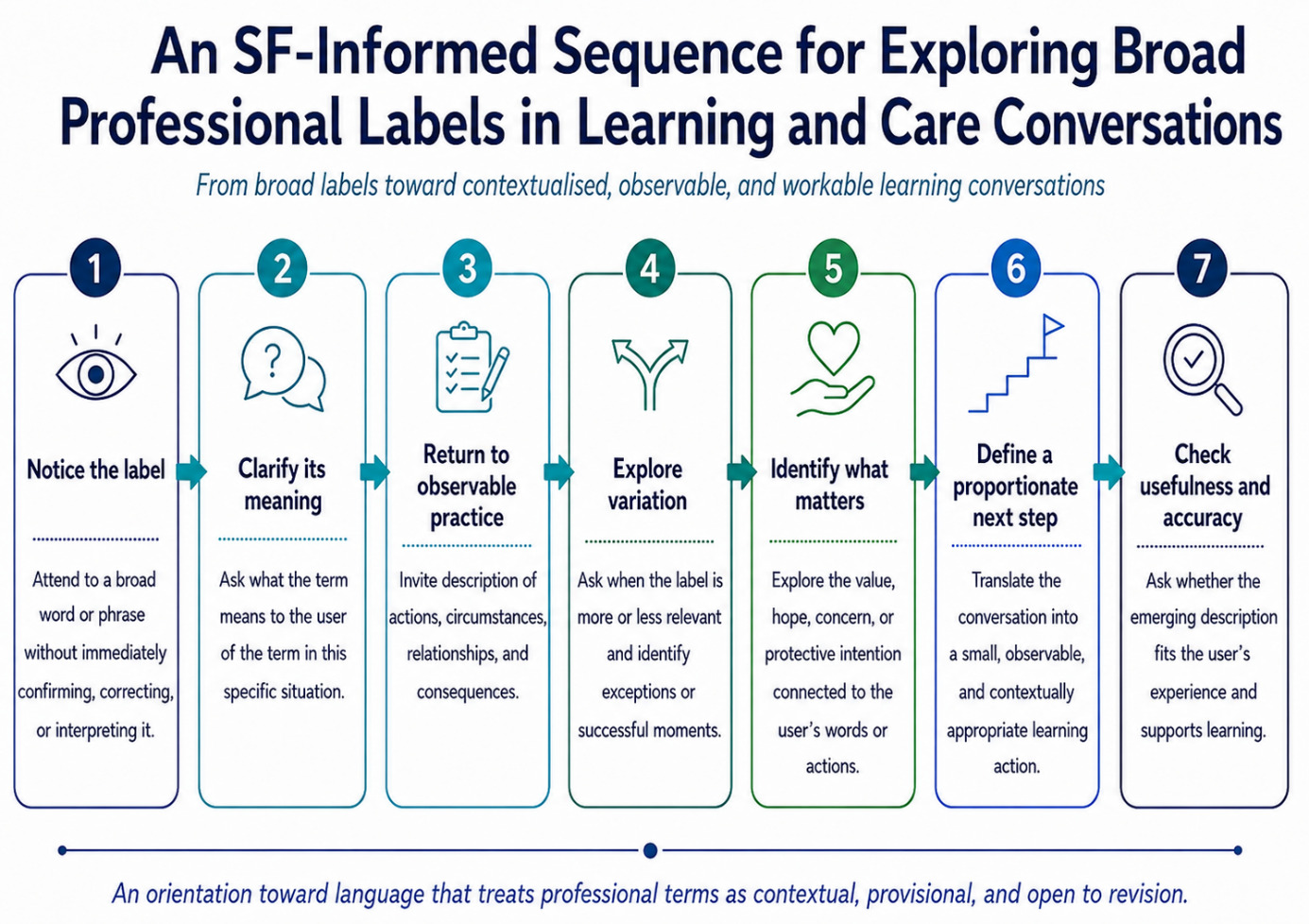
Although the vignettes are situated in clinical placement supervision, the underlying conversational challenge is not unique to placement. Figure 1 therefore presents the sequence as a transferable orientation for professional learning and care conversations, provided that it is adapted to the relevant roles, setting, and accountability requirements.
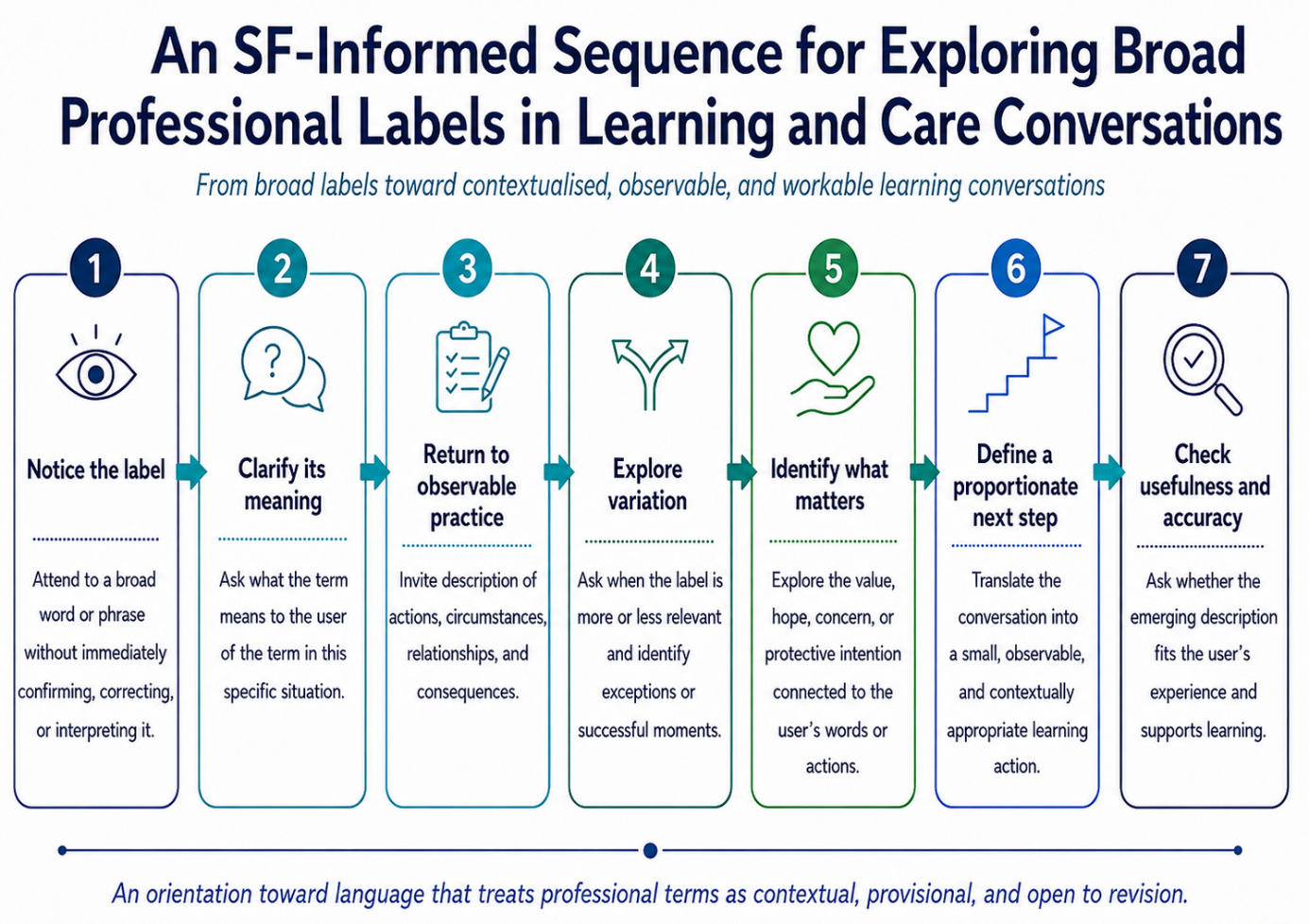
This sequence is not intended as a rigid method. In higher education and university settings, it may invite greater language sensitivity and an SF orientation in programme-team meetings, student-support discussions, and mid- or final placement meetings—particularly when staff move from speaking about students to speaking with them. Similar attention may be relevant in primary, secondary, and early childhood education, including pupil-review meetings and class councils where such structures are used, with participation taking age- and developmentally appropriate forms. In each case, terms such as ‘unmotivated’, ‘not ready’, ‘too dependent’, or ‘not engaged’ can be related back to the particular observations, contexts, existing resources, and preferred next steps to which they refer.
Conceptually, the same orientation may also be relevant in other care and social-care settings, including mental health services. Daily handovers, transfer discussions, and interdisciplinary meetings often require concise language for coordinating care; yet familiar, taken-for-granted descriptions—such as ‘attachment difficulties’, ‘boundary issues’, ‘borderline’, ‘acting out’, ‘manipulative’, ‘attention-seeking’, ‘non-compliant’, or ‘revolving-door patient’—can shape how colleagues subsequently interpret a client or patient and how that person is invited to participate. A language-sensitive SF stance calls for a distinction between necessary professional judgement and a global identity claim: link concerns to observable circumstances; explore variation, resources, and what matters to the person; and, wherever possible, develop the emerging understanding with—not merely about—the client or patient.
The vignettes suggest a possible route through which SF clinical placement supervision and mentorship may support psychological safety in placement learning.
When feedback is not experienced as proof of a fixed personal deficiency, students may be more willing to engage with difficult learning conversations.
At the same time, direct feedback remains necessary when practice, safety, or professional standards demand it. Exploring language can make the basis and implications of that feedback clearer. There is no sugarcoating here. Students need to understand what the feedback is based on, why it matters, and what it means for their practice.
Limitations and Reflexivity
This article has several limitations. First, the four vignettes are composite constructions. They draw on recurring themes from clinical placement supervision but do not reproduce recorded conversations, verbatim dialogue, or the developmental trajectory of individual students. Their purpose is illustrative; no claims about supervisory effects can be drawn from them.
Second, the article does not provide outcome evidence. The shifts described in the vignettes are conceptual possibilities, not observed changes in students’ professional behaviour, confidence, participation, or placement outcomes. No students, supervisors, or mentors were followed over time, and no pre- or post-intervention measures were used.
Third, student and mentor voices are represented indirectly. Although the article foregrounds student-centred supervisory conversations, the perspectives presented are reconstructed through the author’s practice-based account. Future empirical work could use consented recordings of placement conversations, interviews with students, supervisors, and mentors, reflective logs, and multi-perspective analysis to examine which conversational interventions participants experience as useful.
Finally, the selection and interpretation of the vignettes are shaped by the author’s professional position and theoretical commitments. The article privileges a systemic, interactional, semantic, and Ericksonian reading of supervisory language. Other perspectives may identify different educational priorities, relational dynamics, or risks. The author is not positioned outside the linguistic processes examined here: selecting labels, constructing vignettes, and interpreting conversational moves inevitably contributes to particular accounts of students and supervision. The proposed orientation should therefore itself remain open to critical reflection and contextual revision. The purpose is therefore primarily to present a transparent and discussable conceptual lens on clinical placement supervision.
Conclusion
This article has examined how SF clinical placement supervision and mentorship may respond to broad professional labels in undergraduate nursing placements. Terms such as ‘letting go’, ‘perfectionist’, ‘not assertive’, ‘closeness and distance’, and ‘knowing one’s place as a student’ may appear to describe a student clearly. However, when their meaning remains assumed, they can narrow how students understand themselves and make feedback difficult to translate into action.
The article proposes opening professional labels to inquiry and contextual exploration. S/Ms can ask what a term means in the present situation, how it relates to observable actions, when it is more or less relevant, what the student already manages, and what small next step would be meaningful.
Across the vignettes, familiar labels are brought back to the situations in which they are used and acquire their meaning—a move consistent with Wittgenstein’s understanding of language-games. The expressions ‘perfectionist’, ‘assertive’, and ‘knowing your place’ acquire meaning through their use in a particular supervisory conversation and clinical context. Asking what happened, what was observed, and what is expected next makes these meanings more explicit and turns broad judgements into workable learning goals. Accountability and professional expectations remain clear because they too are articulated in concrete terms.
When a broad label enters a placement conversation, it can become the beginning of a more precise, respectful, and collaborative learning conversation.
Perhaps this argument can conclude with a final example of a particularly playful move within the supervisory language-game. In a personal communication, Myriam Le Fevere de Ten Hove (January 19, 2026) elegantly captured the paradox of perfectionism:
“The pinnacle of perfectionism is being able to accept little mistakes. Being able to accept little mistakes—that is true perfectionism. So actually, you still need to step it up a notch …”
Read as a definition, the statement appears self-contradictory. Read as a move within a language-game, however, it does something rather different: it changes what ‘perfectionism’ can mean and what the word allows someone to do next. The familiar rule of the game—describing oneself as a perfectionist means avoiding mistakes by doing more, checking more, and getting things exactly right—is momentarily unsettled. Within another game, accepting that something is sufficiently good may itself become the more demanding achievement. Nothing hidden about the student has thereby been discovered, nor has one label simply been replaced by another. The word is being used differently, and with that shift different possibilities for action become conceivable. Perhaps that is the final invitation of this article: when a professional label seems to close down a learning conversation, the first move may not be to change the student, but to change the language-game in which the label is doing its work.
Acknowledgements
The author would like to thank Myriam Le Fevere de Ten Hove for her repeated careful and critical readings of earlier versions of this manuscript, and for the precision and nuance of her feedback, which created opportunities to further refine the manuscript’s treatment of theoretical and historical concepts.
Declaration of Conflicting Interests
The author declared no potential conflicts of interest with respect to the research, authorship, and/or publication of this article.
Use of Generative AI
Generative AI was used to support language editing, structural revision, and the generation of the figure included in this manuscript. The author reviewed and revised all generated material and takes full responsibility for the accuracy, originality, integrity, and final presentation of the manuscript.